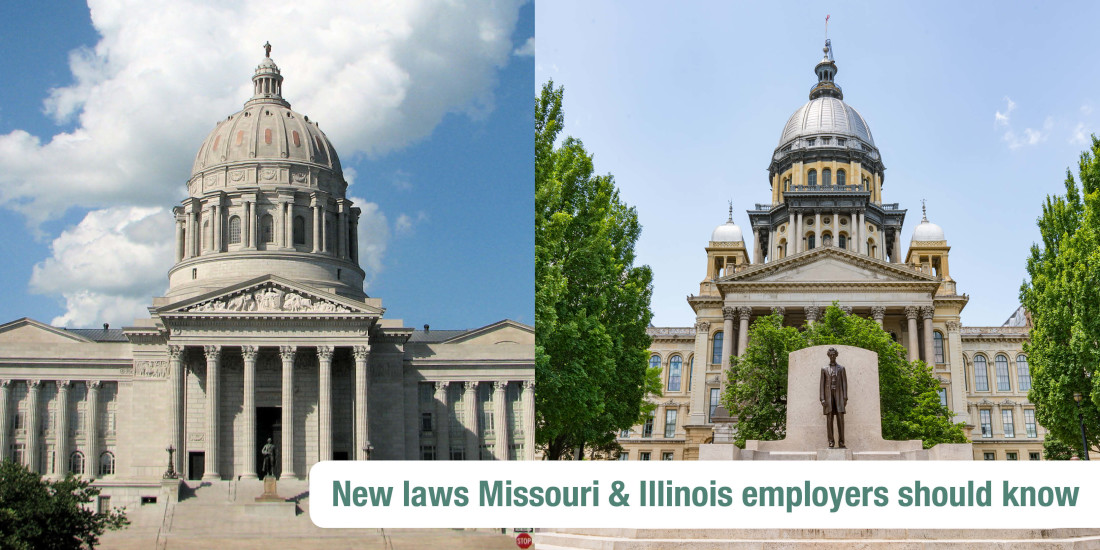
Employers in Missouri and Illinois saw the passage of several new employment-related laws in 2018. Below is a look at some legislative highlights of 2018 and how they might affect your business in 2019.

Missouri update and preview

Minimum wage: Thanks to the success of Proposition B, which Missouri voters approved in the Nov. 6, 2018 election by a 2-to-1 margin, Missouri’s state minimum wage rises to $8.60 per hour on Jan. 1, 2019. The minimum wage will increase by 85 cents each year through 2023, when it reaches $12 per hour. Beginning in 2024, the minimum wage will increase each year based on the cost of living. Although employers are free to pay wages in excess of the state minimum wage, local governments may not set municipal minimum wages higher than the state’s as the Missouri legislature pre-empted such action in 2017.

Medical marijuana: Missouri has joined the ranks of several states permitting individuals to obtain prescriptions for the use of medical marijuana. According to the Missouri Department of Health and Senior Services, individuals will likely not be able to fill their medical marijuana prescriptions until January 2020. The department will begin accepting applications for cultivation, manufacturing and dispensing facilities on Aug. 3, 2019.

Amendment 2 does not permit a person to bring a claim against an employer or prospective employer for wrongful discharge, discrimination or any similar cause of action or remedy, based on the prohibition of being under the influence of marijuana while at work or disciplining the individual for working or attempting to work while under the influence. Practically speaking, once medical marijuana becomes available in Missouri, employers will need to evaluate how to respond to a positive drug test for an individual with a valid prescription and whether accommodations should be made under state and federal disability discrimination laws based on the essential functions of the position the employee is performing. Missouri has not yet issued regulations to address these issues, but we expect to learn more about the reaches of this law and how courts will interpret it as the year progresses.

It is important to note that Missouri’s new medical marijuana law does not supersede any requirements for federal contractors under the federal Drug Free Workplace Act.

Illinois update and preview

Reimbursing expenses: Effective Jan. 1, 2019, the Illinois Wage Payment and Collection Act (IWPCA) requires employers to reimburse employees for “all necessary expenditures or losses incurred by the employee within the employee’s scope of employment and directly related to services performed for the employer.” 820 ILCS 115/9.5(a). “Necessary expenditures” are defined as “all reasonable expenditures or losses required of the employee in the discharge of employment duties and that inure to the primary benefit of the employer.” There is some debate about the reach of this definition, but employee advocates have argued that it includes all types of business-related expenses, including work-related mileage; personal cell phones, internet, and/or office equipment for employees who work from home or out of the office; and costs associated with required all work-related travel, including conferences and training. Interestingly, the law does provide several carve-outs to reimbursable expenses, including any losses due to an employee’s own negligence, loss due to normal wear and tear, and theft, unless the theft was attributable to the employer’s negligence.

The statute does provide that employers can maintain their own written reimbursement policies and employees who do not comply with such policies are not entitled to reimbursement. Violation of the statute can lead companies to be liable for damages equal to the reimbursement amount and a 2 percent penalty for each month the expenses are not paid, as well as attorneys’ fees incurred by employees.

To manage these new requirements and to ensure compliance, Illinois employers should review and revise existing reimbursement policies to provide that expenses that were not previously covered are now reclassified if they are incurred for the primary benefit of the employer. Similarly, policies should set out specific submission deadlines and authorization requirements, whether expenses require supporting documentation, and the process for seeking reimbursement.

Paid nursing breaks: Effective Aug. 21, 2018, the Illinois Nursing Mothers in the Workplace Act requires employers to provide paid break time to mothers who need to express milk while at work. Notably, the law previously only required reasonable unpaid time for such breaks. The paid break time may run concurrently with any break time already scheduled, but the employer cannot reduce an employee’s compensation for time used for the purpose of expressing milk or nursing. Practically speaking, if a nursing mother needs more time throughout the day to express milk than what is already provided for in the schedule (including an unpaid meal break time and paid breaks), she should be provided with the additional break time and paid for it, as long as it is reasonable and does not cause an undue hardship as defined by the Illinois Human Rights Act (IHRA). The amendment provides that this accommodation is limited to one year after the child’s birth.

In working with a new mother to develop a workable plan, an employer should not be afraid to discuss what break time the employee will need, as well as production needs so that both parties understand the arrangements and needs going forward. Illinois employers should review current nursing/lactation break policies and practices to ensure compliance with the amendment.

Equal pay protections for African-Americans: The Illinois Equal Pay Act was amended to include protections for African-American employees, similar to the protections already provided to employees based on sex. Specifically, the statute provides that “No employer may discriminate between employees by paying wages to an African-American employee at a rate less than the rate at which the employer pays wages to another employee who is not African-American for the same or substantially similar work on jobs the performance of which requires equal skill, effort, and responsibility, and which are performed under similar working conditions” (820 ILCS 112/10(a)).

There are a few exceptions, including when payment is made under:

  1. a seniority system;
  2. a merit system;
  3. a system that measures earnings by quantity or quality of production; or
  4. a differential based on any other factor other than race or a factor that would constitute unlawful discrimination under the Illinois Human Rights Act.

Accordingly, it is all the more important for employers to properly document expectations, performance and discipline to defend against allegations of unequal pay.

Illinois Human Rights Act Changes: The IHRA’s notice requirement has been updated to require a new notice to be included in Illinois employers’ handbooks, as well as posted onsite. The poster became available in September 2018 and can be found here. The poster explains that employees have the right to be free from job discrimination and sexual harassment and provides information on how to report discrimination, including contact information for the Illinois Department of Human Rights (IDHR) and the Illinois Sexual Harassment and Discrimination Helpline. The posting requirement is applicable to all employers in Illinois with one or more employees. Accordingly, employers should ensure that the proper notice is posted and included in their handbooks and policies.

Additionally, the IHRA now provides that individuals may opt out of the IDHR’s administrative investigation process and proceed directly to Illinois state court. The individual must still file a charge of discrimination with the IDHR but now may send notice of his or her intent to opt out of the IDHR investigation. Once the request is granted, the individual has 90 days to file suit in state court. The new language and procedural steps are incorporated into 775 ILCS 5/7A-102(B).

Finally, the IHRA also now provides an aggrieved party with 300 days to file a Charge of Discrimination from the date of the alleged discrimination with the IDHR. The act was amended to fall in line with the 300-day filing deadline for charges filed with the Equal Employment Opportunity Commission. The new language and procedural steps are incorporated into 775 ILCS 5/7A-102(A).

Illinois Service Member Employment and Reemployment Rights Act (ISERRA): Effective Jan. 1, 2019, ISERRA consolidates most existing Illinois employment statutes providing protections to service members and specifically repeals the Military Leave Absence Act, Public Employee Armed Services Rights Act, Municipal Employees Military Active Duty Act, and Local Government Employees Benefits Continuation Act. ISERRA incorporates the protections and benefits of the federal Uniform Services Employment and Reemployment Act (USERRA) and, thus, will allow Illinois courts to refer and rely on federal precedent when interpreting ISERRA. While there are several changes, the most prominent changes to existing law are to the definition of “military service,” leave protections and performance review treatment on reinstatement.

ISERRA expands USERRA’s definition of “military service” to include:

  1. service covered by the Illinois State Guard Act;
  2. a period during which service members are absent from employment for medical or dental treatment for a condition, illness or injury sustained or aggravated during a period of active service; and
  3. service in a federally recognized auxiliary of the U.S. Armed Forces when performing official duties in support of military or civilian authorities as a result of an emergency.

Under ISERRA, service members are not required to get permission for military leave but simply required to give employers advance notice of pending qualified service. Additionally, on reinstatement, service members must be credited with the average of performance ratings or evaluations received for the three years preceding the military leave, except when the average is less than the rating on the evaluation just prior to service.

ISERRA also creates an “ISERRA Advocate” in the Illinois Attorney General’s Office that will assist service members and employers with questions regarding the benefits of the statute. The statute contains a posting requirement, which can be downloaded from the Illinois Attorney General’s website. The Illinois legislature also gave ISERRA some teeth by providing a private cause of action to individual employee claimants and enforcement authority to the Illinois Attorney General. The law negates any statute of limitations to bring suit and authorizes the recovery of actual damages, attorneys’ fees and up to $50,000 in punitive damages.

Illinois employers should review existing policies and practices to ensure compliance with the new law and post the required notice of rights.

If you have questions about any of these Missouri and Illinois updates, or if you would like to discuss how your business may be affected, please contact any of the attorneys in our Employment & Labor Group. To read about national updates in 2018 and 2019 that may be relevant to your business, check out this post.

2018 was a relatively quiet year in federal employment law developments, but the stage is set for a much more active 2019. Below is a summary of major federal employment law headlines and a look at what employers can expect in 2019.

For Missouri and Illinois employers, a review of 2018 state updates and a look forward at 2019 can be found here.

Supreme Court update and preview

Arbitration: The Supreme Court gave class action waivers in arbitration agreements the green light in 2018’s Epic Systems decision, but the court is considering even more cases involving arbitration in the current term, all of which may impact employers. First, in New Prime Inc. v. Oliveira, the court decided that the exception under the Federal Arbitration Act (FAA) for “contracts of employment of seamen, railroad employees, or any other class of workers engaged in foreign or interstate commerce” was meant to exempt from arbitration all workers in the transportation industry, whether they are independent contractors or employees. In other words, all transportation workers may bring claims against their employers in court — even if they have signed otherwise valid arbitration agreements.

In two other cases, Henry Schein Inc. v. Archer and White Sales Inc. and Lamps Plus Inc. v. Varela, the court is considering gateway issues of arbitrability: 1) whether a court may decline to send a case to an arbitrator to decide arbitrability — even when the parties have clearly and unmistakably agreed that the arbitrator should decide such a question — if the court determines the arbitrability claim is “wholly groundless,” and 2) whether courts may apply state law to resolve ambiguous contract language in arbitration agreements in determining whether the parties have agreed to arbitrate claims on a classwide basis. In early January, the court decided Henry Schein, finding that when a contract delegates the arbitrability question to an arbitrator, a court may not override the contract, even if the court thinks the arbitrability claim is wholly groundless. The court’s decision in Lamps Plus will further inform how employers structure their arbitration agreements with employees.

Discrimination: In Mount Lemmon Fire District v. Guido, the court found that state and local governments are considered “employers” under the Age Discrimination in Employment Act (ADEA) regardless of the number of employees they have. The ADEA explains that an “employer” means a person with “twenty or more employees” and “also means … a State or political subdivision of a State.” The court interpreted this provision to require that state and local governments be regarded as employers under the ADEA even if they have fewer than 20 employees.

In January, the court agreed to hear Fort Bend County v. Davis, which considers a procedural question: May employees bring claims under Title VII in federal court if they didn’t first bring the complaint to the Equal Employment Opportunity Commission (EEOC)? The circuits are split on this issue, with three circuits holding that federal courts cannot hear claims that were not first presented to the EEOC. Eight circuits have found that the lack of an EEOC complaint is not a complete bar to bringing a claim in federal court, but employers may successfully dismiss such claims by timely asserting that the plaintiff did not exhaust administrative remedies by first filing with the EEOC. The Seventh Circuit follows this theory, and the Eighth Circuit has not taken a position on the issue.  

The court is also considering whether it should take up a trio of cases that question whether Title VII prohibits discrimination on the basis of sexual orientation, gender identity and transgender status. Three cases involving these issues have been “rescheduled” and for consideration by the court multiple times this term and were most recently listed to be discussed at the court’s Jan. 4 and 11 conferences. When the cases are discussed at future conferences, the justices may decide whether they will hear the cases, or they may postpone consideration further. If the court does take up one or more of the three cases, it could resolve a major lingering question (and circuit split) about how far Title VII’s prohibition on discrimination “because of sex” extends.

Federal update and preview

Although there was much more activity at the state level with respect to new employment laws and legislation in 2018, there were a few important federal law changes employers should be aware of as they head into the new year. Additionally, there were plenty of proposed rules that may become law in 2019.

New consumer rights and disclosures under the Fair Credit Reporting Act: When employers use consumer reports to make employment decisions, including hiring, retention, promotion or reassignment, they must comply with the Fair Credit Reporting Act (FCRA). Part of that compliance includes informing consumers of their rights under the FCRA. Specifically, Section 609 of the FCRA requires two consumer disclosures: a Summary of Consumer Rights, which includes information on obtaining and disputing information contained in consumer reports and to obtain credit scores; and a Summary of Consumer Identity Theft Rights, which is a summary of rights of identity theft victims. In May 2018, the Economic Growth, Regulatory Relief, and Consumer Protection Act was signed into law and amended the FCRA to revise certain consumer rights and implement new disclosure requirements. Most notably, the act amended FCRA section 605 to require nationwide consumer reporting agencies to provide a national credit freeze free of charge to consumers. A credit freeze prevents credit bureaus from providing credit information to lenders while in effect and is designed to make it more difficult for criminals to use stolen information to fraudulently open new accounts and credit cards. Not only are consumers now entitled to a free credit freeze, but they are also entitled to receive notice of this right. Whenever a consumer receives a summary of rights required under the FCRA, section 605A(i)(5) also requires that reporting agencies provide consumers with a notice informing them of their rights to obtain a security freeze. Similarly, the act amends the FCRA to substantially extend the minimum time that nationwide consumer agencies must include an initial fraud alert on a consumer’s file from 90 days to one year.

Amendments to the Fair Labor Standards Act affecting tipped employees: The omnibus budget bill, titled “Consolidated Appropriations Act, 2018,” was passed by Congress and signed by President Donald Trump on March 23, 2018. It included an important amendment to the Fair Labor Standards Act (FLSA) for tipped employees. Specifically, the bill provides that an employer may not keep tips received by its employees for any purpose, including allowing managers or supervisors to keep any portion of employees’ tips, regardless of whether the employer takes a tip credit.

Proposed changes to the National Labor Relations Board’s joint employer test: In 2015, the National Labor Relations Board (NLRB) in the Browning-Ferris decision, ruled that a joint employer relationship could be found if an entity had mere indirect or potential control over individuals employed by another entity. This holding reversed the decades-old precedent in which the NLRB had long held that a joint employer relationship could only be found if one entity had “direct and immediate control” over individuals employed by another entity. In December 2017, the NLRB in Hy-Brand Industrial Contractors, Ltd., expressly overruled Browning-Ferris, and returned to its previous stance on the joint employer relationship. Specifically, the board held that for a joint employer relationship to exist, there must be proof that the alleged joint employer exercised direct and immediate control over essential employment terms. The board further held that control that is merely limited and routine would not be sufficient to support a finding of joint employer status. On Feb. 26, 2018, the NLRB vacated its Hy-Brand decision, thereby reinstating — for the time being, at least — the Browning-Ferris standard for joint employer status. On Sept. 14, 2018, the board proposed a regulation that would clarify that separate employers would only be considered joint employers of a particular group of employees if the two employers actually exercise substantial direct and immediate control over the employees’ essential terms and conditions of employment. The board clarified that indirect influence and contractual reservations of authority would no longer be sufficient to establish a joint-employer relationship.

Proposed changes to the salary level threshold under the Fair Labor Standards Act: The Wage and Hour Division of the U.S. Department of Labor has indicated it intends to propose an updated salary level threshold in 2019 for the “white collar” exemptions to the overtime requirements under the FLSA. While the Obama administration attempted to increase the salary threshold from $455 per week to $913 per week in 2016, a federal court in Texas issued a nationwide injunction just prior to its implementation. In 2017, the Wage and Hour Division requested and received public comment on the proposed salary threshold. In its Fall 2018 Unified Agenda of Regulatory and Deregulatory Actions, the Trump administration formally announced its intention to issue a Notice of Proposed Rulemaking  in March 2019 “to determine the appropriate salary level for exemption of executive, administrative and professional employees.”

Proposed revisions to the Occupational Safety and Health Administration Electronic Reporting Rules: On July 30, 2018, OSHA issued a proposed rule change to abolish much of the existing electronic reporting obligations for large employers (those with 250 or more employees). Currently, these employers are required to electronically submit injury and illness data on Form 300 (Log of Work-Related Injuries and Illnesses) and Form 301 (Injury and Illness Incident Report). In an effort to address concerns about the release of private information in this process, OSHA is proposing that only summary data be submitted via OSHA Form 300A. OSHA anticipates a final rule effecting this change will be adopted in June 2019.

If you have questions about any of the topics addressed in this update, or if you want to discuss how these issues may affect your business, contact any of the attorneys in our Employment & Labor Group.

Restaurant bill with tip moneyOn Nov. 8, 2018, the Department of Labor (DOL) issued an Opinion Letter reviving its 2009 guidance that eliminated the 80/20 rule for tipped workers. The rule prohibited employers and businesses from paying tipped workers below the minimum wage by way of a tip credit for non-tipped work when such work comprised more than 20 percent of their day. Under the Obama administration, the 2009 Opinion Letter was withdrawn, which restored the 80/20 rule and sparked a flurry of lawsuits alleging that tipped workers spend more than 20 percent of their time performing non-tipped work for which they did not receive the minimum wage. After finding the rule was confusing and nearly unworkable, the DOL has done away with it once again.



Under the Fair Labor Standards Act (FLSA), when an employee is “engaged in an occupation in which he customarily and regularly receives more than $30 a month in tips,” the employer may pay a reduced wage of $2.13 and claim a tip credit equal to the difference between the wage paid and the federal hourly minimum of $7.25, for a credit of $5.12. See 29 U.S.C. § 203(m). The 80/20 rule acted to limit use of the tipped wage rate of $2.13 per hour when a tipped worker spent more than 20 percent of his or her time on non-tipped work. Stated differently, employers could only apply a tip credit to time spent on non-tipped work if such duties did not exceed 20 percent of the employee’s time.

Pursuant to the DOL Field Operations Handbook section 30d00(e), employers are permitted to take a tip credit for time spent on duties related to the tipped occupation, even though such duties were not by themselves directed toward producing tips. However, where an employee is routinely assigned to non-tipped work or spends a substantial amount of time performing non-tipped duties, no tip credit may be taken. As the DOL notes in its Nov. 8 Opinion Letter, this caused some confusion. For example, in Fast v. Applebee’s Int’l, Inc., 502 F. Supp. 2d 996 (W.D. Mo. 2007), the court held the rule prohibited employers from taking a tip credit for duties unrelated to the tip-producing work and for duties related to the tip-producing work if the duties exceeded 20 percent of the employee’s working time. By contrast, the court in Pellon v. Business Representation Int’l, Inc., rejected the Fast court’s holding that the 20 percent limitation applied to related duties. 528 F.Supp.2d 1306 (S.D. Fla. 2007), aff’d, 291 Fed. Appx. 310 (11th. Cir. 2008). The Pellon court said, “nearly every person employed in a tipped occupation could claim a cause of action against his employer if the employer did not keep perpetual surveillance or require them to maintain precise time logs accounting for every minute of their shifts.” Pellon, at 1314.

In rescinding the 80/20 rule, the DOL said it does “not intend to place a limitation on the amount of duties related to a tip-producing occupation that may be performed, as long as they are performed contemporaneously with direct customer-service duties and all other requirements of the Act are met.” The DOL further said employers should determine upfront which duties are related and unrelated to a tip-producing occupation so they can comply with the FLSA. For reference, the DOL pointed to the Occupational Information Network website and says duties listed as core or supplemental for the appropriate tip-producing occupation in the Tasks section shall be considered directly related. For example, for waiters and waitresses, direct tasks can include duties such as sweeping, vacuuming and cleaning bathrooms. If a task is not contained on the Tasks list, employers may not take a tip credit for time employees spent performing those tasks.

What does this mean for employers with tipped workers? While employers no longer need to keep track of how much time their workers spend on certain tasks now that the 80/20 rule has been abandoned, employers should still make sure tipped employees are performing tasks related to the tip-generating work. If you have questions about specific tasks or would like more information on the DOL’s Opinion letter, please contact one of the attorneys in our Employment & Labor Department.

Thanks for joining LexBlog! We’re excited to help you create great legal content. This post shares some important information to help you with your new site. It covers topics such as logging in to the platform and where to find help articles or support. We’ve also added some of our favorite blog posts as placeholder content below. They will be automatically deleted from your site when you launch.

Continue Reading Getting started with LexBlog

When planning a new blog or evaluating your current blog, measurable goals help you determine if your site is successful. The LexBlog philosophy of blogging skews away from content marketing and toward connection and reputation building. Who you connect with, be it a colleague or client, should be your desired outcome.

Continue Reading Setting your site goals and measuring your success

Imagine you’re an estate planning lawyer in Des Moines looking to grow your practice.

The marketing folks at Principal Park, home of the Triple A Des Moines Cubs, call to tell you that you’ll have free use of a luxury box for five of next year’s ball games. Better yet, they tell you they’ll arrange for the food and drink and invite a who’s who in networking for a Des Moines estate lawyer.

Continue Reading Listening: First step in blogging by lawyers

When people ask me what they should do to get started on blogging, I rarely talk technology or even blogging. While those are important elements of blogging, they are next steps. Things you do after you decide you want to blog and have found your community and your voice.

Continue Reading Before you blog, find your community

Focusing your blog around niche topics will increase your readership and search engine performance. If your blog covers too many topics, it becomes harder for people to find related content on your site and for search engines to understand what your site is about. Here are some ways to narrow the focus of your site.

Continue Reading Figuring out your blog’s focus