
GINA Blog PostWhat does your mother’s high blood pressure have to do with your job protection? According to the Equal Employment Opportunity Commission (“EEOC”): everything.

A virtually unknown and unused federal anti-discrimination statute—which applies to employers with fifteen (15) or more employees—is quickly taking center stage with the EEOC. For the second time in a month, the EEOC has filed suit alleging violations of the Genetic Information Nondiscrimination Act (“GINA”). 

The cases—EEOC v. Founders Pavilion, Inc. and EEOC v. Fabricut Inc.—challenge the defendant employers’ practices of requiring employees to answer questions about their family medical histories in conjunction with pre-employment examinations. In both cases, the employers required employees to submit to pre-employment medical examinations that included inquiries about family medical history—the results of which were given to the employers for consideration in the employment process. In fact, Founders Pavilion required this information in conjunction with its employees’ return-to-work and annual medical examinations.

Fabricut, which the EEOC filed on behalf of one individual, settled for $50,000.00 and injunctive relief within days of its filing. Founders Pavilion, on the other hand, is the EEOC’s first class lawsuit under GINA and has not been subject to any substantive rulings, given its recent filing. That being said, GINA is particularly clear on what is prohibited conduct under the Act.

Not surprisingly, GINA prohibits discrimination and harassment due to a person’s genetic information. (Genetic information includes family medical history and various information related to genetic testing.) Also not surprising is that GINA prohibits employers from retaliating against employees who file charges of discrimination or otherwise oppose discrimination based on genetic information.

What may be surprising, however, is that GINA prohibits employers from even acquiring genetic information about their employees. In other words, except under limited circumstances, employers should not receive reports from employees’ physicians that contain genetic information.

The Act does provide for some exceptions, such as certification for Family and Medical Leave Act (“FMLA”) leave to care for a family member and voluntary wellness programs (provided that certain conditions are met). Perhaps most importantly, overhearing an employee talking about a family member’s illness will not subject the employer to liability (unless, of course, the employer discriminates against or harasses the employee based on that information).

The bottom line: if pre-employment, return-to-work or annual medical examinations are part and parcel of your employment practices, limit the information that you receive from the physicians. At the end of the day, the employer need only know one thing—whether an employee is fit for duty. The rest should stay locked in the physician’s files.

Employee Handbook“We’re all throwing the dice, playing the game, moving our pieces around the board, but if there is a problem the lawyer is the only person who has read the inside of the top of the box.” – Jerry Seinfeld

Employers often find it difficult to set and manage their expectations for employees. Like playing a board game, however, managing employees is markedly easier and purposeful when the rules are clear, widely read and consistently followed. Workplaces, like board games, operate smoother and more efficiently when everyone is aware of and familiar with the rules. And, like board games, people are best served to read the rules before beginning.

Employee handbooks serve as the rules and instructions in the workplace. While nearly all employers have policies that they follow either formally or informally, not all employers take advantage of the benefits associated with recording those policies and compiling them into a handbook that they can distribute to all employees at the outset of employment.

There are a few ways in which handbooks are unlike the rules of a board game.

Unlike game rules, handbooks can and should state that the policies can be amended at a later date. There are a number of reasons for this, including changes in the employer’s business and changes in the law. Employment law is a rapidly-changing field. Accordingly, unlike game rules, handbooks should be reviewed regularly to determine if revisions are needed. Likewise, the handbook can distinguish between types of employees and the rules applicable to those types. For example, an employer who has salaried employees and hourly employees may have different attendance, vacation and/or work schedule policies for each. In Monopoly, by contrast, each player collects $200 for passing Go regardless of whether they are the dog, the shoe, or the top hat.

Preparing an employee handbook requires careful consideration. Misstating laws or employer practices can lead to problems. A well-written handbook, however, can help set employee expectations, provide guidance for future problems, and limit employer liability. Because employee handbooks typically speak to a wide variety of topics, the best practice is to work with an attorney to prepare a handbook that best suits your business.

Some topics to consider when preparing your handbook:

  • Mission statement. Describing the company’s mission or goals will help focus the employer’s task of drafting and enforcing work policies. It can also help create a shared purpose with employees and aid in interpreting policies if a dispute arises.
  • Employment at will. Most employees are at will, which means there is no legally-enforceable employment contract between the employer and employee. An employer that is under the assumption its employees are at-will should include a clear disclaimer that the employee handbook does not constitute an employment contract.
  • Written policies vs. actual practices. Your handbook should clearly set forth employment policies. To be effective, however, employers should follow those policies. In employment disputes, courts will examine an employer’s actual practices along with their written policies, so having a well-thought-out policy is unhelpful if the employer does not abide by the policy.
  • Non-discrimination policy and anti-harassment policy. Handbooks should make clear that the employer will not tolerate any form of discrimination or unlawful harassment and that the employer will not retaliate against employees who report discrimination or harassment. Employers should consult an attorney regarding what types of employees are protected by federal, state and local laws and include appropriate statements about those protected classes. For example, while sexual orientation and transgender employees are not necessarily protected by federal law, many states and municipalities expressly provide coverage. Also, anti-harassment policies should contain at least two methods for reporting harassment. Furthermore, employers should expressly incorporate anti-harassment and anti-discrimination policies into internet and e-mail usage policies.
  • Discipline procedures. Some employers use a progressive discipline policy. If an employer chooses to use a progressive discipline policy, employers should make clear that it has the latitude to skip levels of discipline if based on the individual circumstances and conduct at issue.
  • Attendance. There are many issues to consider with regard to attendance policies. Is your company covered by the Family and Medical Leave Act (FMLA)? Does your attendance policy distinguish between excused and non-excused absences? How much vacation / sick leave / paid time off (PTO) are employees given? Are employees required to submit doctors’ notes to justify sick days? Does your state and local law permit a “use it or lose it” PTO policy?
  • Standards of Conduct. While standards of conduct and employer expectations are helpful, the manner in which those standards are described could be problematic. For example, the National Labor Relations Board has found that some prohibitions on disrespectful conduct or offensive language could infringe on employees’ right to engage in concerted activity. Employees are entitled to discuss their wages, hours, benefits and working conditions even if it will sometimes result in speaking unfavorably about the employer, supervisors or co-workers.
  • FMLA Policy if you are covered. If your organization is covered by the FMLA (50 or more employees within a 75 mile radius), you must include your FMLA policy in your employee handbook.
  • Safe Harbor Policy. Employers are prohibited from making deductions from an exempt employee’s salary except in very limited circumstances. However, the Department of Labor (DOL) provides employers with an affirmative defense if an employer has a clearly communicated policy prohibiting deductions with a complaint procedure.
  • Email and Internet Use. Again, an employer’s right to monitor employee internet and e-mail use will vary among states. However, where an employer does have the right to monitor use, such as in Missouri, employers should expressly notify employees that they have the right and will exercise their right to monitor information accessed or sent through the employer’s e-mail and Internet systems.
  • Acknowledgement. All handbooks should contain a form that states the employee has received, read and understood the handbook. That form can be a separate page which is kept in the employee’s file.

Preparing a handbook can and probably should be an involved process. But taking time to think through issues and policies in creating a handbook can help minimize disagreements and employer liability.

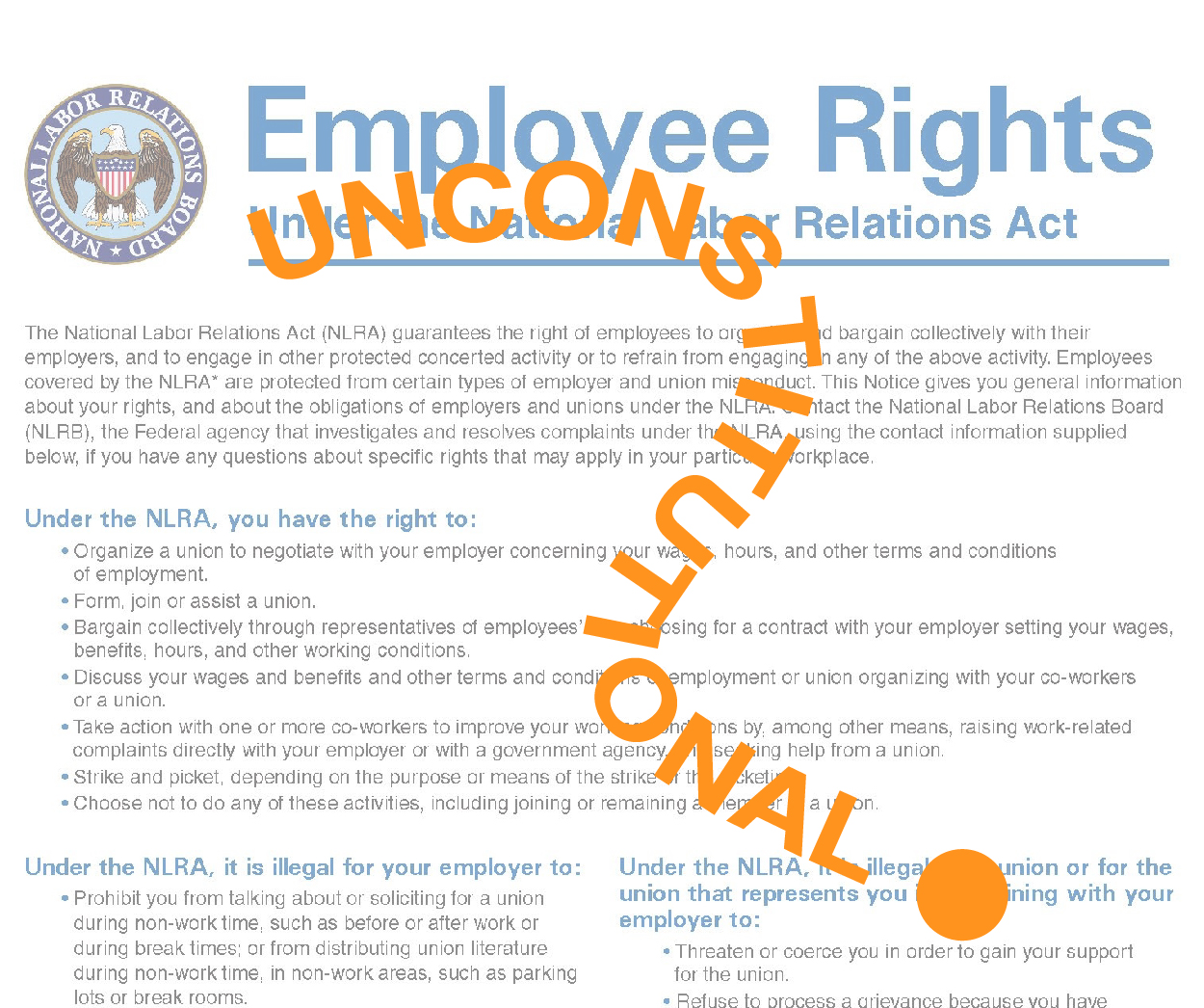
Employee Rights poster with unconstitutional across it.Intra-Session NLRB Recess Appointments Invalid: The United States Court of Appeals for the Third Circuit recently became the second federal appellate court to find one of President Obama’s intra-session recess appointments to the National Labor Relations Board unconstitutional, thus raising further question of the Board’s current authority. The Third Circuit held that the appointment of Craig Becker to the NLRB failed to satisfy constitutional requirements, thus invalidating a bargaining order issued by a Board panel of which Mr. Becker was a member. The Third Circuit’s decision followed a D.C. Circuit decision earlier this year in which the D.C. court ruled that President Obama’s three most-recent intra-session recess appointments were unconstitutional.

These decisions raise serious questions about recent and future actions by the NLRB. If President Obama’s recess appointments are invalid, the NLRB presently lacks a quorum. Accordingly, unless these decisions are overturned on appeal (the Department of Justice has petitioned the Supreme Court for review of the D.C. Circuit decision), the NLRB arguably lacks authority to render any legally binding decision, other than holding labor elections or investigating unfair labor practices.

NLRB Notice Poster Requirement Unconstitutional

The Third Circuit’s decision comes only days after the D.C. Circuit declared that the NLRB’s Employee Rights notice poster unconstitutional. The controversial poster included information about employees’ rights to form or join a union and the right to strike or establish picket lines. The poster also lists certain employer conduct which is prohibited under the NLRA. Implementation of the posting requirement was delayed several times.

What This Means For Employers

Although two federal appellate courts have held President Obama’s recess appointments unconstitutional, expect no change in the business of the NLRB. Following the D.C. Circuit opinion, Chairman Pearce (the only member of the NLRB confirmed by the U.S. Senate) declared “business as usual” shortly after the decision was announced. Given the pending appeal to the Supreme Court, it is unlikely the NLRB will change its stated position.

On the other hand, the D.C. Circuit’s decision could mean an end of the notice poster rule. That is, unless the NLRB seeks an appeal to the Supreme Court.

Employee using time clock to punching in/out of workLate last year the Seventh Circuit reversed prior precedent and held that an associate who is minimally qualified must be reassigned to a vacant position as a reasonable accommodation in EEOC v. United Airlines, Inc.. 2012 U.S. App. LEXIS 18804 (7th Cir. 2012). That decision, coupled with the EEOC’s focus on fixed-leave policies as violating the Americans with Disabilities Act (“ADA”), has caused much angst among employers as they struggle to square lean staffing models with the ADA’s duty to accommodate.

This month the Seventh Circuit took a more practical view when it affirmed dismissal of a former employee’s ADA claims in a case in which the employee was unable to meet the requirement of providing regular, reliable attendance in Basden v. Prof’l Transp., Inc., 2013 U.S. App. LEXIS 9293 (2013). The employee’s attendance problems were apparently linked to a possible diagnosis of multiple sclerosis (“MS”). 

The employer provided around-the-clock ground transportation service. The plaintiff, who had been employed for less than a year as a dispatcher, had received numerous written warnings pursuant to the Company’s attendance policy for various absences, at least some of which were associated with possible MS. After she was suspended for three days for absenteeism, she submitted a request for a 30-day leave of absence. The Company’s policy required an employee to be employed for one year before requesting a 30-day leave. The Company denied the leave and fired the employee, who in turn sued. The Seventh Circuit affirmed summary judgment in the employer’s favor. In doing so the Seventh Circuit summarized prior case precedent holding,

An employer is generally permitted to treat regular attendance as an essential job requirement and need not accommodate erratic or unreliable attendance… A plaintiff whose disability prevents her from coming to work regularly cannot perform the essential functions of her job, and thus cannot be a qualified individual for ADA purposes… Her ability to come to work, or to otherwise perform the essential functions of her job, is examined as of the time of the adverse employment decision at issue… In response to an employer’s motion for summary judgment, it is the plaintiff’s burden to produce evidence sufficient to permit a jury to conclude that she would have been able to perform the essential functions of her job with a reasonable accommodation. 2013 U.S. App. LEXIS at *5-6 (Internal citations omitted).

The Court found that the employee’s evidence that medication improved her condition, that she had hoped for enough improvement to return to work regularly after leave, and that she subsequently had brief employment that was interrupted by a 2-week absence was insufficient to support a finding that she was able to come to work regularly at the time of her termination, or that her regular attendance could have been expected with the leave that she sought or with any other accommodation.

The takeaways here are as follows:

  1. Make sure you have updated your job descriptions to stress the importance of regular, reliable attendance, particularly if you have a 24-hour operation.
  2. When determining whether to extend leave as an accommodation, look closely at the individual’s circumstances to determine the employee will likely be able to perform the essential functions of his/her job if the leave is provided. (Note that this case could have turned out much differently if the employee had evidence that her condition would have improved during the 30-day requested leave such that she could perform her job or another vacant position.)
  3. Despite the fact that this employer stuck to a hard and fast 30-day leave policy and it turned out okay, that will not always be the case. Inflexible leave and attendance policies expose organizations to individual claims and claims from the EEOC. Instead of adhering to inflexible leave policies, consider whether the requested leave will enable the employee to work. If it will not, then base your decision to deny leave on that factual finding.

Checklist with boxes and a penIf you think this sounds like a “bad joke,” think again. The United States Department of Labor (“DOL”) has been quite transparent as of late that it is ramping up its FMLA investigatory activities to include unannounced, on-site visits. Although the DOL has historically called employers to arrange on-site visits, particularly for FMLA investigations, the DOL has determined that unannounced, on-site visits is a more effective use of the DOL’s time and resources for both FLSA and FMLA investigations. The DOL’s practice concerning Visits to Employers is described in DOL Fact Sheet #44.

So, exactly what do you do to prepare for the unannounced visitor? 

Fortunately, help is already available and more help is on the way. Below are some steps that you can and should take now:

– Review your FMLA policy and practices to ensure compliance with the latest regulations effective March 8, 2013. In the words of the DOL, if you’ve made no changes since the new regulations became effective, you aren’t compliant.

– Review the DOL’s updated FMLA forms released in February 2013, to ensure that your forms are compliant.

– Schedule training with your managers to ensure that they are aware of the Company’s obligations under the FMLA and understand the FMLA’s non-retaliation and anti-interference provisions. The DOL recently released a PowerPoint presentation on the Family and Medical Leave Act, which is publicly available at: http://www.dol.gov/whd/fmla This is a great start for supervisor training, but you will want to add some information about tips for managers in communicating with their employees about leave, particularly providing notice of leave, as well as certification and recertification obligations.

– Watch for the FMLA Field Operations Manual, which the DOL is very close to releasing. This will be similar to the FLSA Field Operations Manual already available and will be a key tool for your leave of absence team as it will contain the exact information that the DOL’s field investigators use.

– And finally, check this blog for further developments! In particular, the DOL is closely following the Supreme Court’s review of the Defense of Marriage Act (“DOMA”). Since the FMLA already defines marriage with a deference to state law, if DOMA is found to be unconstitutional by the United States Supreme Court, it is almost a certainty that the FMLA will be extended to same sex partners in states that recognize same sex marriage.

Stay tuned for other exciting developments.

Performance Evaluation Attendance PaperworkClients frequently seek advice concerning tips for avoiding and/or defending against employment discrimination claims. Read this blog entry for some tips you should consider.

Document performance deficiencies. We often see in our practice that managers will give a verbal warning to an employee but will never write it down or put a notation in the employee’s personnel file. When it comes to defending employment claims, juries are much more likely to believe an employer when prior instances of poor performance have been documented.

Just the facts. Closely related to the above item is the issue of poor documentation. Often supervisors struggle to report just the facts when they do document performance concerns. Train your managers to remove emotion from the documentation process. Emotionally charged supervisor notes can paint a worse picture than no documentation at all.

Don’t inflate employee evaluations. Many supervisors do not want to have difficult conversations with their employees about performance. Accordingly, they avoid these conversations and then give employees an artificially high performance evaluation. However, this presents major difficulties when an employer later takes the position that an employee’s performance was deficient.

Conduct prompt, thorough investigations. If an employee brings a complaint to the Company’s attention, we recommend that a prompt, thorough investigation be conducted. This should include interviewing all witnesses. While there is no requirement that you share the nature of any disciplinary action that has been taken with the employee, you should inform the complaint that his/her concerns have been addressed.

Is it fair? Remember that juries for the most part make their decisions on the basis of whether they feel that an employee has been treated fairly and whether the employee has had the opportunity to correct past mistakes. So, if it doesn’t pass the fairness test, go back to the drawing board before proceeding to termination.

OSHA Accident Free PosterOSHA has continued its proactive approach to targeting and inspecting businesses in 2013. It’s not like it used to be, when you could expect to be clear of an OSHA inspection if you kept your employees happy (i.e., no complaints to OSHA) and safe (i.e., no reportable accidents). If you met those two goals not long ago, then you were likely in the clear to avoid OSHA inspections in any given year.

That is no longer the case. As many of you may be aware, OSHA has implemented a Site-Specific Targeting Program designed to target the most dangerous employers, as measured by their DART (“days away [from work], restricted, or transferred) rate. Under the program, employers with a DART rate higher than their industry’s average are on the list for greater likelihood of inspection. This enforcement program is a marked change from OSHA’s historical approach of primarily investigating actual incidents and/or complaints.

So, did you make the list?? You would know if you did—according to the Bureau of National Affairs, OSHA mailed 9,414 letters this year to employers who did, down from about 14,950 letters in 2012 and about 14,640 in 2011.

If you made the list, your first step is to understand why you are on it—in particular, to ensure that the information that OSHA utilized accurate. Even more, you should make sure that the information you gave to OSHA (in the form of your OSHA 300 logs) is accurate and is the type of information required to be on the report. Sometimes, the fix is that easy. If not, then a more detailed dive into your safety program and work environment is needed so that you are ready for the likely inspection, and so that you can get off the list!

Drug test results sheetThe use of medical marijuana is currently authorized in 18 states and the District of Columbia. Two of these states—Colorado and Washington—have also legalized the recreational use of marijuana. Despite these recent changes in state law, marijuana remains illegal under federal law, creating confusion as to how the passage of these laws will affect employers’ rights in the workplace.

The simple answer is that state laws legalizing marijuana (whether for medicinal or recreational use), do not change an employer’s rights. Federal law still prohibits the use of marijuana, even for medicinal purposes. 

Likewise, Colorado’s new law specifically provides that it will not affect the right of an employer to prohibit the use, possession, or transfer of marijuana on the employer’s property. Similarly, Washington’s law does not establish any job protection rights for employees who use or possess marijuana. Consequently, employers may still enforce drug-free workplace policies. In fact, employers with federal grants or contracts that meet certain criteria must continue to maintain drug-free workplaces. Similarly, employers subject to federal drug-testing regulations, such as employers with safety-sensitive jobs regulated by the Department of Transportation, must continue to comply with these regulations.

However, employers seeking to maintain drug-free workplaces should carefully review and potentially revise their drug and alcohol abuse policies to prevent employee confusion. For example, drug and alcohol policies that prohibit only “illegal” drug use should be revised to prohibit the use of any drug which is illegal under federal or state law. In addition, because marijuana can remain in the system for days after off-duty use, employers should modify policies prohibiting working under the influence to prohibit any detectable amount of any drug or controlled substance illegal under federal or state law. In addition, employers should carefully review applicable state anti-discrimination laws that may require additional accommodations for current or former illegal drug users beyond those required by the Americans with Disabilities Act. In other words, while state laws authorizing marijuana usage do not diminish employers’ rights to enforce drug-free policies, careful policy review and revision may be necessary to ensure compliance with federal law, prevent employee confusion, and ensure compliance with applicable anti-discrimination laws.

Man with smartphone in business buildingThe Northern District of Illinois recently certified* a class action in a case alleging that employers should pay overtime wages for time employees spend checking their e-mail after hours. The police officer who sued the city of Chicago claims the Police Department had an “unwritten policy” requiring officers to check their BlackBerry after normal working hours without compensation. Checking their BlackBerry, the officer claimed, constituted substantive police work and the department would have been significantly less successful in accomplishing its goals without regular required BlackBerry use.

The court has not ruled on the crux of the claim. But in certifying the class, Magistrate Judge Sidney Schenkier found some merit to the allegations. “Here, plaintiff has made a modest factual showing that Sergeants and Lieutenants in the BOC believed that they were expected to check and possibly respond to emails and calls made to their department-issued BlackBerry while they were off-duty without being compensated for these activities.”

Initially ridiculed, the lawsuit is now viewed as a potential game-changer for many employers. Under the Fair Labor Standards Act (“FLSA”), employers must pay time and a half for all hours an employee works in excess of 40 in a workweek. An employee may not waive his or her entitlement to overtime wages. Not all employers are covered by FLSA, and not all employees are entitled to overtime wages. In addition, some states have overtime laws which overlap FLSA.

Those employers who are covered by FLSA should carefully review their smart phone or remote access policies (and practices) to determine if they require employees to perform uncompensated work. Employers should also be sure they are complying with FLSA’s record keeping requirements. Short of these two steps, however, there is little employers can do besides wait for additional guidance from the courts or the Department of Labor. One thing is for sure: more litigation on this subject is around the corner.

*Allen v. City of Chicago, Case No. 10 C 3138, Northern District of Illinois

chess piecesOn January 25, 2013, the US Circuit Court of Appeals for the D.C. Circuit (Noel Canning v. NLRB) invalidated President Obama’s appointment of Sharon Block, Terence Flynn and Richard Griffin to the National Labor Relations Board based on the court’s conclusion that the three “recess” appointments failed to meet the requirements of the US Constitution. This decision calls into question over a year’s worth of Board decisions as well as the Board’s authority to act at present and for the indefinite future; however, NLRB Chairman Pearce indicated that the agency would take a “business as usual” approach until all appeals were exhausted. On March 12, the Administration announced that it would seek US Supreme Court review of the Noel Canning decision.

In response to the NLRB Chairman’s response to Noel Canning, and the Administration’s decision to seek Supreme Court review, congressional members in both branches of Congress initiated action purportedly designed to halt or limit current NLRB action. On March 20, The House Committee on Education and the Workforce passed a bill sponsored by House Health, Education, Labor and Pensions Committee Chair Phil Roe (R-Tenn.) that would require the NLRB to cease all enforcement activity until Noel Canning is fully resolved or NLRB members are properly appointed (H.R. 1120). On March 21, Sen. Lamar Alexander, the ranking Republican on the Senate Health, Education, Labor and Pensions Committee, submitted a budget amendment to eliminate NLRB funding targeted for the enforcement of decisions or regulations issued by the NLRB “whose quorum was constituted by invalid recess appointment.” (S. Amdt. 349).

Though these actions appear serious on the surface, they are of little practical consequence. Although Republicans hold a majority in the House, it is unlikely the House Bill, or the amendment proposed by Senator Alexander will gain any traction in a Democrat-controlled Senate. Further, given the Administration’s decision to challenge the DC Circuit’s ruling, it is even less likely that any such bill would survive the President’s desk. Political posturing aside, expect the NLRB to continue to render decisions, and seek enforcement of its decisions and regulations.