
Businessman calling timeoutWith the Dec. 1, 2016, deadline for the Department of Labor (DOL) Final Overtime Rule approaching, employers across the country are urgently working to implement new compensation and classification practices. But recently, the DOL has been facing much criticism and resistance, as evidenced by a duo of federal lawsuits filed last week and a House vote to delay the rule’s implementation.

The first suit was filed by a coalition of 21 states, and the second by a coalition of business groups led by the U.S. Chamber of Commerce. Both sets of plaintiffs argue that the DOL was “arbitrary and capricious” in adopting the new threshold — i.e., that the department ignored evidence in the record and failed to sufficiently explain the basis for its new rule, which more than doubles the salary-level threshold for employees to be exempt from overtime.

Further resistance came Sept. 28, when the House Rules Committee debated proposed legislation, introduced by Rep. Tim Walberg (R-Mich.), that would delay implementation of the final rule. The legislation, known as The Regulatory Relief for Small Businesses, Schools and Nonprofits Act, would delay the rule until June 2017, if the Senate were to also pass it and if it were signed by the president.

Walberg argued before the committee, stating, “We all agree our nation’s overtime rules need to be updated and modernized …. the administration should withdraw the rule completely and update our laws responsibly. Unfortunately, the clock is ticking. A six-month delay provides much needed relief.”

Rep. Rob Woodall (R-Ga.) also spoke regarding his support for the bill, noting that while the rule was necessary to update a standard that had not been addressed for more than a decade, it was implemented too quickly and without enough time for employers to react. Woodall argued, “To double [the salary threshold] overnight with virtually no warning to the small business community, the nonprofit community, the education community, is not the right way to govern.”

Despite numerous Democratic objections and the potential threat of a presidential veto, the House agreed. With a vote of 246 to 177, the House determined a delay was necessary and that the final rule’s effective date should be pushed back an additional six months.

We are closely tracking any updates to the status of the DOL’s final rule and will keep blog readers informed once the proposed legislation reaches the Senate for debate. If you have questions in the meantime, please contact any of the attorneys in our Employment & Labor Group.
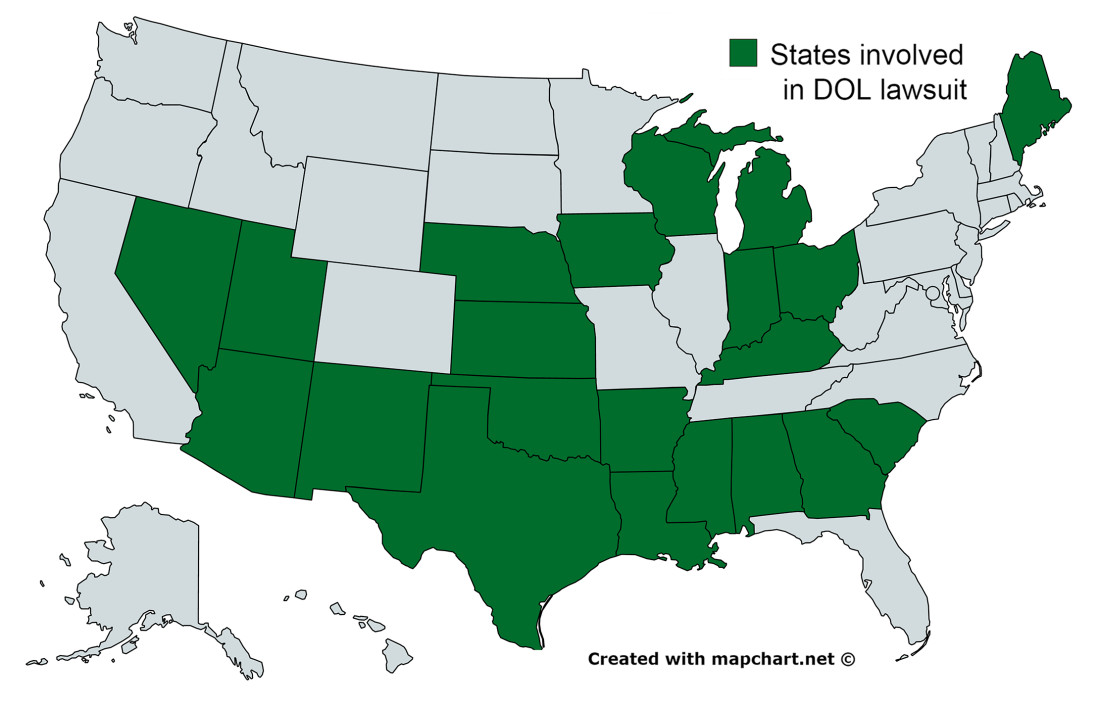
States involved in DOL lawsuitTwenty-one states have filed suit against the federal government seeking a preliminary and permanent injunction to block the Department of Labor’s new overtime rule and declare it unlawful.

In the 30-page complaint filed Sept. 20, 2016, the states allege that the Obama administration is trying to impose heavy costs and its own policy initiatives, in violation of the 10th Amendment to the Constitution. On March 13, 2014, President Barack Obama ordered the DOL to revise the Fair Labor Standards Act’s overtime exemption to account for the federal minimum wage. The DOL complied and released its final rule on May 18, 2016. 

The rule, which we summarized in a previous post here, more than doubles the salary-level threshold for employees to be exempt from overtime. Consequently, after Dec. 1, 2016, all employees are entitled to overtime if they earn less than the new threshold of $913 a week — including state and local government employees. This change would require states to increase salaries for tens of thousands of employees, or reclassify those employees as hourly, likely cutting back on their time and reducing the services available to the public.

The states argue in their lawsuit that the final rule not only threatens their budgets, but it represents an encroachment upon the rights of states and inappropriate federal overreach in violation of the 10th Amendment. They further allege the salary level change does not take into consideration what duties employees are actually performing and is something that ultimately should have been decided at the state and local level. Neither Missouri nor Illinois were among the 21 states to file suit.

We will keep blog readers updated on the status and outcome of this lawsuit, but if you have questions in the meantime, please contact any of the attorneys in our Employment & Labor Group

The Department of Justice recently released its final rule extending coverage of the ADA Amendments Act (ADAAA) to Titles II and III of the Americans with Disabilities Act. This final rule, which takes effect Oct. 11, 2016, updates those titles to include the ADAAA.

Title II covers local and state governmental entities, and Title III covers places of public accommodations, including many types of private businesses that are open to the public and commercial facilities. 

 President George W. Bush signed the ADAAA into law effective Jan. 1, 2009, and authorized the attorney general to issue regulations under Titles II and III of the ADA.  The ADAAA applies to Titles I, II and III, and this final rule takes into account Executive Order 13563 (which called for coordinated rules and regulatory requirements across agencies) in its attempt to coordinate with the Equal Employment Opportunity Commission’s regulations incorporating the ADAAA in 2011. 

Signed into law in 2008, the ADAAA expanded the ADA’s coverage by redefining several key terms in the statute. In particular, that included what constitutes a “disability” for purposes of the statute’s coverage. The ADAAA overruled several Supreme Court decisions that narrowed the definition of “disability.”

Pursuant to the ADAAA, an individual’s disability under the ADA should not require deep inquiry, and covered entities should focus more on their responsibility to not discriminate against an individual based on disability rather than determining whether the person is disabled.  In addition, the final rule expands the definition of “major life activity” and more fully expounds upon the term “substantially limits,” both of which are key factors in determining whether an individual is disabled. 

With the implementation of the final rule, these expanded definitions apply to state and local governmental entities, as well as private businesses that qualify as places of public accommodation. Covered entities should be aware of these changes and continue to focus on fostering an inclusive environment to ensure individuals are treated fairly regardless of circumstance.

To see the full text of the final rule, click here.  If you have questions about this final rule or how the ADA and these changes affect your company, please contact our Employment & Labor Group.  

Instead of taking effect Aug. 10, OSHA anti-retaliation provisions impacting post-accident drug-testing policies are now deferred until Nov. 1.The enforcement of anti-retaliation provisions in new injury and illness reporting regulations for employers has been delayed until Nov. 1, 2016.

On May 11, 2016, the Occupational Safety and Health Administration (OSHA) published the final rule revising its regulations on the recording and reporting of occupational injuries and illnesses. The final regulations, which require employers to electronically submit information about workplace injuries and illnesses, also bar employers from retaliating against workers for reporting such incidents.

The electronic record-keeping provisions of the final rule are not taking effect for qualifying establishments until July 1, 2017. However, the anti-retaliation provisions impacting post-accident drug-testing policies were scheduled to take effect on Aug. 10, 2016 but are now deferred until Nov. 1, 2016. The anti-retaliation rule initially provided that beginning Aug. 10, employers would be required to:

  • Inform employees of their right to report workplace injuries and illness;
  • Inform them employers were not permitted to retaliate;
  • Establish and widely communicate a reasonable procedure for employee reporting; and
  • Provide employees and their representatives with access to non-redacted illness and injury records.

OSHA’s official reason for pushing back the implementation of the anti-retaliation provisions to Nov. 1 is to provide more guidance to employers. Yet many suggest that the effective date is delayed because the provisions have been challenged in a Texas lawsuit brought by eight employer groups including the National Association of Manufacturers. The groups are asking for injunctive relief from the new rule generally, or at least as it would apply to employer safety incentive programs and routine mandatory post-incident drug testing. In addition, they are seeking a declaratory judgment that the new rule exceeds OSHA’s statutory jurisdiction and authority.

We will continue to keep you posted on any OSHA updates to the final rule. In the meantime, if you have questions about record-keeping, reporting or any of the OSHA final rule provisions, please contact our Employment & Labor Group

“Married on Saturday … fired on Monday”: Seventh Circuit holds Title VII doesn’t protect against sexual orientation biasOn July 28, 2016, the U.S. Court of Appeals for the Seventh Circuit ruled in a precedential decision that existing civil rights laws do not protect against sexual orientation discrimination. Although it was a unanimous decision, the court expressed great displeasure and conflict with the “illogical” legal structure in which “a person can be married on Saturday and then fired on Monday for just that act.”

The court’s decision, spanning 42 pages, discusses the many inconsistencies in the law following the U.S. Supreme Court’s decision last summer in favor of same-sex marriage.

The appeals court upheld the dismissal of a lawsuit brought by Kimberly Hively, a part-time adjunct professor at Ivy Tech Community College. Hively claimed she was repeatedly not offered a full-time position because of her sexual orientation. The court, seemingly conflicted and reluctant to make the ruling, found that Hively could not overcome the motion to dismiss for the simple fact that the Seventh Circuit has previously declared that claims for sexual orientation are not cognizable under Title VII. 

In her opinion, Judge Ilana Rovner wrote that, “From an employee’s perspective, the right to marriage might not feel like a real right if she can be fired for exercising it.” And while Rovner noted that a change is needed to close the gap that exists in federal civil rights law, until that change comes in the form of new legislation or a Supreme Court decision, the court must adhere to its prior precedent.

Although no other federal appeals courts have decided the issue of whether Title VII’s employment protections extend to discrimination on the basis of sexual orientation, there are at least two other circuit courts considering the issue. Additionally, the U.S. Equal Employment Opportunity Commission has held that sexual orientation is “inherently a sex-based consideration,” and it recognized last summer that firing someone who is gay or lesbian is sex discrimination.

Given how apparent it is throughout the decision that the Seventh Circuit felt its hands were tied, we expect Supreme Court intervention soon. Additionally, LGBT advocates are calling for Congress to pass the Equality Act, legislation that would amend the Civil Rights Act to explicitly include sexual orientation and gender identity among the prohibited categories of discrimination. The EEOC also filed its first lawsuits in March accusing private employers of gender bias for sexual orientation discrimination.

If you have questions about sexual orientation or gender identity discrimination, or how employers will be affected if those become prohibited categories of discrimination, contact our Employment & Labor Group.

Following new rules issued on employer wellness programs, the Equal Employment Opportunity Commission on June 16 released an example of how employers should communicate with their employees about the medical information those programs obtain.

In May, the EEOC issued final rules clarifying that Title I of the Americans with Disabilities Act (ADA) and Title II of the Genetic Information Nondiscrimination Act (GINA) allow employers to use incentives to encourage participation in wellness programs that include disability-related inquiries and/or medical examinations as long as the programs are voluntary and the incentives do not exceed certain limits. Now, the EEOC has provided an example of how employers that offer these wellness programs may notify their employees about the specifics.

What information must the notice contain?

The “ADA notice” must describe what medical information will be obtained through the wellness program, how it will be used, who it will be disclosed to and how the employer will keep the medical information confidential. This notice must be drafted so that employees are “reasonably likely” to understand it.

What form must the notice take?

As long as employers create notices that contain the information described above, they are not required to use the exact language provided in the EEOC’s example. Employers may choose any format for their notices, as long as they reach all employees who are offered the chance to participate in a wellness program. For example, employers may provide hard copies of the notice or email the notice to employees. Employers must also make available notices that accommodate employees with disabilities. For example, a large-print version may be provided to employees with vision impairments, and sign-language interpreters may be provided to communicate the notice to employees with hearing impairments.

Are employers required to provide a similar notice to employees’ spouses who participate in a wellness program?

The new rules do not alter the authorization that must be provided to employee spouses who provide current or past health status information in the course of an employer’s wellness program under GINA. The GINA authorization requires employers to obtain prior, knowing, written and voluntary authorizations from an employee’s spouse before the spouse completes a health risk assessment. Like the ADA notice, this authorization must describe the genetic information that is being obtained, how it will be used and any restrictions on its disclosure.

If an employer already provides a HIPAA notice, is a separate ADA notice necessary?

It depends. If an employer’s Health Insurance Portability and Accountability Act (HIPAA) notice already describes what information will be collected, who will receive it, how it will be used and how it will be kept confidential, a separate ADA notice is not necessary. However, if this information is not contained in the HIPAA notice, or if the HIPAA notice is difficult for employees to understand, an employer should provide an ADA notice.

What practical steps should employers take to comply with the ADA notice requirement?

The final rules go into effect next year, and employers must comply by the first day of the wellness program plan year that begins after Jan. 1, 2017. Although the rule does not require that notice be provided by any certain time, employers must still provide the notice far enough in advance that employees have a chance to decide whether to participate in the program. Additionally, the notice must be provided before an employee provides any health information, so waiting to provide the required notice until after an employee has already completed an HRA or medical examination is prohibited. Employers should begin planning the content of their notices and when they will be provided.

Employers must also be careful to draft their notices so that employees clearly understand the information that will be collected, who will receive it, how it will be used and how it will be kept confidential. Employers may now wish to begin thinking through how this information can best be communicated to employees so that it is easy to understand. Although employers may simply wish to revise the sample notice for their purposes, they may also consider drafting a distinct notice. The EEOC warned in its Q&A that if an employee files a charge of discrimination claiming he or she was unaware of a particular aspect of a wellness program, the EEOC will examine the contents of the employer’s notice to determine whether the employee was given adequate notice. In light of this impact the notices may have on an employer’s litigation of claims involving the rule, employers should carefully consider the form and contents of their notices.

For more information regarding the final rules or for assistance in designing a notice that complies with the final rules and other applicable law, contact the attorneys in our Employment & Labor Practice Group.

On May 11, 2016, the Occupational Safety and Health Administration (OSHA) published the much-anticipated final rule revising its regulations on the recording and reporting of occupational injuries and illnesses.

The final rule requires employers to electronically submit information about workplace injuries and illnesses, and it bars employers from retaliating against workers for reporting such incidents. It also requires employers to inform workers of their right to report work-related injuries and illnesses without fear of retaliation and clarifies employees’ rights to access workplace injury data.

Two sets of employers will have to comply with the electronic record-keeping provisions: all establishments with 250 or more workers, and those establishments in designated high-hazard industries with 20 to 249 workers. These qualifying establishments must submit information from OSHA Forms 300A electronically by July 1, 2017, and submit information from all forms (300A, 300, and 301) electronically by July 1, 2018. Beginning in 2019, information from these forms must be submitted electronically by March 2 each year.

In addition to the recording and reporting requirements, the anti-retaliation provisions of the final rule will impact post-accident drug-testing policies beginning Aug. 10, 2016. Though the text of the final rule does not specifically address mandatory post-accident drug and alcohol testing, OSHA’s commentary accompanying the final rule specifies that the agency views mandatory post-accident testing as deterring the reporting of workplace safety incidents.

Specifically, OSHA wants to prohibit employers from using drug testing (or the threat of drug testing) as a form of adverse action against employees who report injuries or illnesses. The agency commented that “drug testing policies should limit post-incident testing to situations in which employee drug use is likely to have contributed to the incident, and for which the drug test can accurately identify impairment caused by drug use.“ It goes on to say that employers do not have to specifically suspect drug use before testing, but there should be a reasonable possibility that drug use was a contributing factor to the reported injury or illness in order for an employer to require testing.

Finally, the new rules provide that it is a violation for an employer to use an incentive program or take adverse action because an employee reports a work-related injury or illness. This includes disqualifying the employee for a monetary bonus or any other action that would discourage or deter an employee from reporting the work-related injury or illness. OSHA recently challenged an employer’s policy of disciplining employees who wait more than seven days to report an injury. In contrast, if an incentive program makes a reward contingent upon, for example, whether employees correctly follow legitimate safety rules rather than whether they reported any injuries or illnesses, the program would not violate the rules. Unfortunately, the rule doesn’t offer details on what incentive provisions would trigger a citation, rather, programs will be viewed on a case-by-case basis.

Employers who do not comply with the new rule face serious penalties for each violation, especially since OSHA has implemented increases that permit maximum penalties to over $12,000 per violation and over $120,000 for willful or repeat violations.

If you have questions about the final rule and the recording requirements or need to update your drug-testing and injury-reporting policies, our Employment and Labor attorneys can help identify and prevent possible OSHA violations.

Circuit split: Do class and collective action waivers in employment agreements violate the NLRAOn May 26, 2016, the U.S. Court of Appeals for the Seventh Circuit issued its decision in Lewis v. Epic Systems, agreeing with the National Labor Relations Board’s position that mandatory arbitration agreements that prohibit employees from bringing class or collective claims violate the National Labor Relations Act. It was the first appellate court decision to accept the board’s stance, breaking with the Fifth Circuit and teeing up the final resolution of the validity of class waivers for the U.S. Supreme Court.

One week later, however, the Eighth Circuit released a contrary decision. In Cellular Sales of Missouri v. NLRB, the Eighth Circuit adopted the Fifth Circuit’s position, while still holding that the actual agreement at issue violated the NLRA due to its broad language.

At issue in both Lewis and Cellular Sales were arbitration agreements that required employees to bring some or all of their employment-related claims through individual arbitration. In Lewis, the court found that seeking legal remedies through class or collective actions is protected concerted activity under Section 7 of the NLRA. The court reasoned that the arbitration agreement’s express prohibition of this concerted activity constituted interference with employees’ exercise of rights guaranteed by the NLRA.

Furthermore, the court found no conflict between the NLRA and the Federal Arbitration Act that would justify enforcing the class waiver. Instead, the court found that the NLRA and the FAA worked “hand in glove” to render the waiver provision unenforceable: “Because the provision at issue is unlawful under Section 7 of the NLRA, it is illegal, and meets the criteria of the FAA’s saving clause for nonenforcement.”

Although Cellular Sales did not adopt this position, the court found that the arbitration agreement’s broad language could reasonably be construed by an employee as prohibiting the filing of charges with the NLRB or otherwise engaging in certain protected concerted activities.

Since Lewis was decided, the NLRB has already cited the opinion in briefs before the D.C. Circuit and the Fourth Circuit, in which similar cases challenging class waivers are pending.

In light of the Seventh Circuit’s decision, employers may wish to review their arbitration agreements, although the validity of class and collective action waivers will remain uncertain until the Supreme Court addresses the issue. At a minimum, employers should ensure that any arbitration agreements include language explaining that employees are free to bring charges related to their employment to the NLRB.

For more information about these cases or employee arbitration agreements, contact our attorneys in the Employment & Labor Practice Group

On May 18, 2016, the U.S. Department of Labor (DOL) released the final rule updating the regulations defining and limiting “white collar” overtime exemptions under the Fair Labor Standards Act (FLSA). These rules apply to workers who fall under the executive, administrative, or professional exemptions from the FLSA’s minimum wage and overtime protections. The rule will go into effect December 1, 2016, giving employers over six months to adjust.

The new rules set the minimum salary threshold for employee exemptions from overtime pay at $47,476 per year ($913 per week). This amounts to a 101% increase above the previous minimum. The “highly compensated employee” exemption has increased from $100,000 to $134,004 per year. These new thresholds will automatically update every three years, beginning on January 1, 2020.

DOL released final rule on overtime exemptions, chart of thresholds

In a change to the salary basis test, nondiscretionary bonuses and incentive payments, including commissions, may satisfy up to 10 percent of the salary basis requirement. However, highly compensated employees must receive at least the full standard salary amount each pay period exclusive of any nondiscretionary bonuses or incentive payments, but these payments may count toward the total annual compensation requirement. Notably, the final rules do not change any job duty requirements that allow employees to qualify for exemption.

The DOL estimates that these new changes will result in approximately 4.2 million currently exempt employees becoming eligible for overtime pay with a projected cost to employers of up to $255 million per year.

In preparation for the rule’s implementation, employers should begin assessing their workforces and determining how best to comply. As a starting point, employers should evaluate their current employees, specifically identifying those employees currently in exempt positions whose salaries fall below the new salary threshold for exemption. Once the employees that will be affected by the new rules have been established, employers may consider the following options:

  • Increasing affected employees’ salaries to meet the new threshold;
  • Reclassifying affected employees as nonexempt and limiting their use of overtime; or
  • Reclassifying affected employees as nonexempt and redistributing work.

In addition to conducting this analysis, employers should vigilantly track all hours worked by their employees. Knowing exactly how many hours each employee works each week will allow an employer to make a more informed decision on how to prepare for the new rules.

If you have questions about the final rules, the classification of your employees, or other FLSA compliance issues, contact our attorneys in the Employment & Labor Practice Group.

On May 16, 2016 the EEOC issued final rules amending the regulations and interpretive guidance implementing Title I of the Americans with Disabilities Act (ADA) and Title II of the Genetic Information Nondiscrimination Act (GINA) with respect to employer wellness programs. These changes clarify that employers may use incentives to encourage participation in wellness programs that include disability-related inquiries and/or medical examinations as long as the programs are voluntary and the incentives do not exceed certain limits. Additionally, the rules confirm that employers may provide incentives when employees’ spouses—but not children—provide certain health information.

Which wellness programs qualify?

An employee health program must be reasonably designed to promote health or prevent disease. In other words, the program must have a reasonable chance of improving the health of, or preventing disease in, participating employees, and must not be overly burdensome, a pretense for violating the ADA, GINA or other applicable nondiscrimination laws, or highly suspect in the method chosen to promote health or prevent disease. For example, conducting biometric screenings for the purpose of alerting employees to health risks that they may be unaware of would qualify as an employee health program. However, collecting medical information from employees on a health questionnaire without providing follow-up advice or using the information to design a program to treat specific conditions would not qualify as an employee health program. A program will not qualify as an employee health program if it excessively burdens employees in terms of costs or time required for their participation or if the program exists mainly to shift costs from employers onto targeted employees based upon their health. Additionally, a program will not qualify if it imposes a penalty on an individual whose spouse’s manifestation of disease or disorder prevents the spouse from participating or from achieving a certain health outcome.

What makes an employee health program voluntary?

In order for an employee health program that includes disability-related inquiries and/or medical examinations to be considered voluntary, the program must meet all of the following requirements:

  • Does not require employees to participate;
  • Does not deny coverage or limit coverage for employees who do not participate (except to the extent of allowed incentives);
  • Does not take any adverse employment action or retaliate against, interfere with, coerce, intimidate or threaten employees who choose not to participate in the employee health program or who fail to achieve certain health outcomes; and
  • Provides employees with a notice that meets the notice requirements specified in the rule.

What incentives may employers offer for participation?

In general, the use of limited incentives (which include both financial and in-kind incentives, such as time-off awards, prizes or other things of value) in a wellness program will not render a wellness program involuntary. However, the total allowable incentive for a wellness program that involves asking disability-related questions and/or conducting medical examinations (such as having employees complete a health risk assessment) may not exceed 30 percent of the total cost of employee-only coverage. For example, if a group health plan under which an employee is enrolled has a total annual premium for employee-only coverage of $6,000 (which includes both the employer’s and employee’s contributions toward coverage), the maximum allowable incentive is $1,800.

Employers may offer an inducement, not to exceed 30 percent of the total cost of employee-only coverage in exchange for individuals who complete risk assessments that include questions about family medical history or other genetic information; the same inducement may be offered for employees’ spouses who provide information about the spouse’s manifestation of disease or disorder as part of a health assessment. Inducements may not be offered to employee spouses who provide their genetic information, including results of genetic tests, or to employee children who provide their health information.

Importantly, the 30 percent limit only applies to programs that ask participants to answer disability-related inquiries, take medical examinations, or provide information regarding family medical history or genetic information. Programs that do not include these requirements, such as attending smoking cessation, weight loss, or nutrition classes, have no limit on incentives available for participation or achievement of an outcome.

How are the ADA’s reasonable accommodation requirements impacted?

All employee health programs are prohibited from discriminating against employees with disabilities. Absent undue hardship, employers must provide reasonable accommodations to enable employees with disabilities to fully participate in employee health programs and earn any reward or avoid any penalty that is part of an employee health program. For example, an employer that offers a financial incentive for employees to attend a nutrition class would be required to provide a sign language interpreter so that an employee who is deaf could earn the incentive.

The final rules will go into effect beginning in 2017. For more information regarding the final rules or for assistance in designing a wellness program that complies with the final rules and other applicable law, contact the attorneys in our Employment & Labor Practice Group.