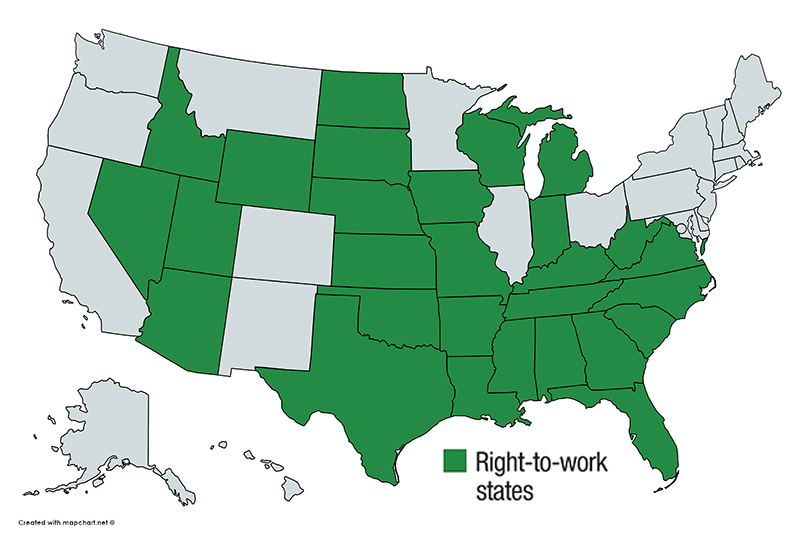
States highlighted in green with right-to-work legislationMissouri has become the 28th state to enact right-to-work legislation banning mandatory union dues. Gov. Eric Greitens signed the bill into law on Feb. 6, 2017, and it will take effect on Aug. 28, 2017.

What does this mean for unionized employers? The law’s grandfather clause offers protection for existing labor contracts negotiated prior to the date the law takes effect. Collective bargaining agreements negotiated after the effective date will no longer be able to condition employment on union membership or payment of union dues. Under the law, violations could result in a misdemeanor or liability for monetary damages to workers and the agreement will be deemed void.

Supporters of right-to-work assert that it will bring more jobs to Missouri. Opponents anticipate that the law will do more harm than good.

National Right-to-Work Act

National legislation titled the National Right-to-Work Act was introduced into the U.S. House of Representatives on Feb. 1, 2017. The bill would amend the National Labor Relations Act to remove language permitting union security clauses whereby employers are permitted to require that workers pay union dues as a condition of employment. Commentators have opined that although there have been attempts at similar legislation in the past, the chance of success is now more real given the Republican majorities in both houses of Congress. Furthermore, while on the campaign trail, President Donald Trump endorsed the right-to-work trend.

Organized labor could take a major hit with the passage of a national right-to-work bill. Millions of workers could potentially opt out of union membership. This would mean less dues money for unions, and likely in turn, less power.

We are monitoring the status of the Missouri and national legislation and will cover new developments as they arise. If you have questions about right-to-work laws and what they could mean for you or your business, please contact any of the attorneys in our Employment & Labor Group.

People joining in tug of war.Last week, 60 business groups and four states joined the fight against the Department of Labor’s new overtime rule by filing amicus briefs in the Fifth Circuit asking the court to uphold the district court’s injunction blocking the rule from taking effect.
Leading the way for the states was Missouri Attorney General Josh Hawley, whose office authored the states’ brief. In their brief, the states argue that the new overtime rule undermines state sovereignty. In a statement, Hawley said that the overtime rule, if implemented, would hurt the Missouri economy. The rule would expand overtime protections,  more than doubling the salary-level threshold for employees to be exempt from overtime.

“I look forward to seeing President Trump roll back these illegal, last-minute regulations,” he said. “Missouri is ready to fight in court to protect our workers and businesses.”

The total number of states challenging the rule now sits at 25. The states that joined Missouri in its brief are Colorado, Montana and Wyoming.

The business groups, in their brief, argued that the Fair Labor Standards Act does not allow the DOL to make such a drastic change to the overtime exemption and that the new rule overly relies on workers’ salaries as the basis for overtime exemption rather than their job duties.  

The DOL’s final brief is due Jan. 31, after which oral argument will be set. Due to fears that the Trump administration will abandon defense of the overtime rule, the Texas AFL-CIO has filed a motion to intervene in the lawsuit so that it can argue in favor of the rule should the administration so decline.

Shoes moving from 2016 to 2017 with pictures of Illinois and MissouriThe Missouri and Illinois legislatures were quite active in 2016 in creating laws affecting employers, and they have been just as busy in the first few weeks of 2017. Below is a summary of employment law developments that may affect your business in those states in the coming year. 

Missouri employment laws

“Permitless” concealed carry law: Effective Jan. 1, 2017, anyone who may legally own a firearm may carry it open or concealed without a permit into most locations in the state. However, this new law does not allow a person (even a concealed carry permit holder) to carry a firearm into a variety of locations without special permission from the owner or manager, including but not limited to: most governmental offices, airports, childcare facilities, schools, gated areas of amusement parks, churches, large sports arenas, hospitals accessible to the public, establishments licensed to dispense liquor, and where it is prohibited by federal law.

The law does not impede Missouri employers from prohibiting employees, even those with concealed carry permits, from bringing a firearm onto company property or carrying a firearm in employer-owned vehicles. Additionally, if the employer’s building is open to the public, the employer can prohibit all who enter from bringing a firearm onto the property by posting a sign stating that firearms are off-limits. The sign must be at least 11 inches by 14 inches and have lettering measuring at least 1 inch. 

Interestingly, House Bill 96 proposes to allow an individual who normally carries a firearm but is prohibited from doing so by a company’s posting and is harmed on the company’s property to bring a private action for damages. For example, this bill could allow a convenience store customer harmed in a robbery or a convenience store employee harmed while at work to sue the store for his or her injuries. The bill reasons that by prohibiting firearms individuals may use for self-defense, the property owner has assumed custodial responsibility for the safety and defense of those on the premises. The bill is not set for a hearing or further process on the House calendar, but if passed, it may affect how Missouri employers view workplace gun policies. 

Missouri minimum wage increase: Missouri’s minimum wage increased to $7.70 as of Jan. 1, 2017. This applies to all Missouri businesses except retail and service businesses with less than $500,000 in gross sales. (Some agricultural employees and certain classifications of employees are also exempt.) Tipped employees’ total hourly wage must equal at least $7.70, with employers required to pay at least 50 percent and to adjust if needed to bring that employee to the minimum wage threshold. Employers should keep in mind that failure to comply could result in misdemeanor charges and civil penalties In addition, employers need to update labor law posters to include this update. See a summary of Missouri Minimum Wage Law here.

Missouri’s right-to-work legislation: Multiple pieces of legislation have been filed in the Missouri House of Representatives and Senate that propose to make Missouri a right-to-work state. The push for this legislation comes on the heels of the inauguration of Republican Gov. Eric Greitens, who has supported right-to-work laws. A right-to-work law would prohibit Missouri employers from requiring workers to become union members as a condition for employment. It is uncertain whether this legislation will affect existing collective bargaining agreements or will only affect agreements entered into after the effective date of the law.

Proposed changes to the Missouri Human Rights Act: The new majority Republican legislature has also been fast at work proposing changes to the Missouri Human Rights Act (MHRA), which, in part, prohibits employers from basing employment decisions on a person’s race, color, religion, national origin, sex, ancestry, age or disability. The flurry of activity follows Greitens’ campaign promise for tort reform, which he reiterated in his recent State of the State address. Specifically, there are three bills (SB43, HB550 and HB552) that propose changes to the statute and the way it should be interpreted by Missouri courts. The amendments seek, in part, to:

  • Change the burden of proof from the current contributing factor standard to a higher burden of proof;
  • Impose caps on damages for a prevailing plaintiff based on the size of the employer;
  • Remove supervisors and others from individual liability under the MHRA;
  • Require Missouri courts to heavily rely on the judicial interpretations of Title VII, the Age Discrimination in Employment Act, and the Americans with Disabilities Act;
  • Require Missouri courts to give a jury instruction stating that the jury is not to second-guess a business decision made by the employer as long as it was made for a non-discriminatory reason, if such an instruction is requested by the employer;
  • Encourage Missouri courts to summarily dispose of cases that lack sufficient facts prior to trial and apply the U.S. Supreme Court’s burden shifting framework used in Title VII cases; and
  • Codify the existing common law exceptions to the at-will employment doctrine by implementing the “Whistleblower’s Protection Act” which, in part, prohibits recovery of unfettered punitive damages by allowing recovery of liquidated damages in egregious circumstances.

If passed, these changes would go into effect August 2017. They would significantly modify the landscape of employment litigation in Missouri and decrease the number of frivolous lawsuits that burden the court’s dockets and cost Missouri employers time and money to defend. Moreover, the addition of the Whistleblower’s Protection Act would make a claim under MHRA the exclusive remedy for seeking recourse for unlawful employment practices in Missouri and eliminate the former common law causes of action.

Illinois employment laws

Illinois Freedom to Work Act: Effective Jan. 1, 2017, Illinois employers are prohibited from entering into non-competition agreements with low-wage workers (those earning $13 an hour or less). This reflects a policy of higher scrutiny toward restrictive covenants so as to ensure that low-wage workers may remain mobile. The practical effects are likely to be minimal, as few employers use restrictive covenants for low-wage workers.

Illinois Child Bereavement Leave Act: New in July 2016, the Illinois Child Bereavement Act requires employers to give eligible employees up to two work weeks per child of unpaid bereavement leave within a 12-month period to attend a funeral for a child, make necessary arrangements after the death of a child, and grieve the death of a child. Covered employers are those with 50 or more employees. Eligible employees are those who have worked for the employer for a total of 12 months, for at least 1,250 hours over those 12 months.

Illinois Employee Sick Leave Act: Applicable to all employers who provide personal sick leave benefits, the Illinois Employee Sick Leave Act entitles employees to use benefits for the illness, injury or medical appointment of a child or grandchild, spouse or domestic partner, parent or stepparent, mother-in-law or father-in-law or sibling. Personal sick leave is still limited by the amount that would accrue in six months at the current rate, and the Employee Sick Leave Act does not extend an employee’s FMLA leave entitlement. This law took effect Jan. 1, 2017.

Illinois Victims’ Economic Security and Safety Act Amendment: Also effective Jan. 1, 2017 was an amendment to the Illinois Victims’ Economic Security and Safety Act. The law affords unpaid leave time for employees who are victims of domestic or sexual violence, or whose family members are victims of domestic or sexual violence, for the purpose of addressing issues related to that violence. The amount of leave available depends on the size of the employer. The amendment adds an additional category of covered employers, ultimately making this type of leave available to more Illinois employees. Specifically under the amendment, employers with fewer than 14 employees now must allow an employee four weeks of unpaid leave in any 12-month period so the employee can handle issues related to domestic or sexual violence. The law requires newly covered employers to post the obligatory notice and update their employment and record retention policies. 

If you have questions regarding how to update policies or implement new laws, please contact the attorneys in our Employment & Labor Group. Stay tuned to our blog for updates throughout the year, and check out our overview of employment law developments on the national level here.

Business shoes moving from 2016 to 20172016 was a busy year for employment law developments on a national level, and 2017 promises to follow suit. To help employers navigate the changes, here is a summary of major developments that may affect your business this year.

Wage and Hour

Overtime exemption rule: After much anticipation, the Department of Labor (DOL) on May 18 released the final rule updating regulations on “white collar” overtime exemptions. The rules, which were to take effect Dec. 1, 2016, would apply to workers who fell under the executive, administrative or professional exemptions from the Fair Labor Standards Act minimum wage and overtime protections. Additionally, they set the minimum salary threshold for employee exemptions from overtime pay at $47,476 per year, from the previous minimum of $23,660.

The DOL quickly faced a great deal of backlash. In September, 21 states filed suit seeking a preliminary and permanent injunction to block the rule and declare it unlawful, as it violates the 10th Amendment. On Nov. 22, a federal judge entered a nationwide injunction blocking the DOL from implementing its rule. The case is pending before the Fifth Circuit Court of Appeals, and briefing will conclude by the end of January 2017.

Interestingly, on Jan. 3, the judge denied the DOL’s motion to stay all proceedings while the appeal is pending. Thus, the court can rule on whether a permanent injunction is appropriate at any time. Additionally, President Donald Trump’s choice for labor secretary, Andrew Puzder, has spoken out against expanding the overtime rule for executives and managers, which could indicate a change in focus for the agency.

Workplace Injury Developments

OSHA Injury Reporting Rule: On May 11, the Occupational Safety and Health Administration (OSHA) published the final rule revising its regulations on the recording and reporting of occupational injuries and illnesses. It requires employers to electronically submit information about workplace injuries and illnesses, bars employers from retaliating against workers for reporting such incidents, requires employers to inform workers of their right to report work-related injuries and illnesses without fear of retaliation, and clarifies employees’ rights to access workplace injury data.

The National Association of Manufacturers and others brought a suit to enjoin the rule, arguing that it went too far. Despite the pending lawsuit, OSHA issued an interpretative guidance on the new rule and it went into effect Dec. 1. On Jan. 4, 2017, the final rule was again challenged, this time by industry groups in Oklahoma that argued it violates employers’ First and Fifth Amendment rights; is arbitrary, capricious and otherwise contrary to law; and oversteps OSHA’s authority.

While it remains to be seen how these challenges will fare, qualifying establishments must comply with the rule and submit information from OSHA Forms 300A electronically by July 1, 2017, and information from all forms (300A, 300, and 301) electronically by July 1, 2018. Employers who do not comply face serious penalties, especially since OSHA has implemented increases that allow maximum penalties of over $12,000 per violation and over $120,000 for willful or repeat violations.

Labor Law Developments

DOL Persuader Rule: The “persuader rule,” issued by the DOL in March 2016, would have required employers and their attorneys to disclose any attempts to persuade employees with respect to union activities, with the exception of pre-existing arrangements. But a federal judge’s decision on Nov. 16, 2016, in favor of plaintiffs challenging the rule has blocked the DOL from enforcing it, meaning that employers may continue to hire legal counsel on unionization issues without facing an argument from the DOL that fees paid to legal counsel must be publicly disclosed. Although the DOL has appealed this ruling in the Fifth Circuit, it is unknown whether the Trump administration will withdraw the persuader rule or refuse to defend its validity.

Enforceability of mandatory class action waivers: On Jan. 13, 2017, the Supreme Court announced it would consider whether mandatory class action waivers in employee arbitration agreements violate the National Labor Relations Act, resolving a circuit split and deciding an issue that has pitted that National Labor Relations Board against most federal courts. Such waivers prohibit employees from banding together and arbitrating employment claims as a class. The NLRB has argued that this violates employees’ rights to engage in “concerted activities,” while federal courts have interpreted the Federal Arbitration Act as allowing such provisions. Although a decision is expected by this summer, the result may be influenced by whether a Trump Supreme Court appointee can be seated before the case is heard. Also complicating the issue, the Trump administration will change the composition of the board, which could lead the board to abandon its current position. 

Employee Reporting Requirements

New Form I-9: Beginning Jan. 22, 2017, employers must use the new edition of the Form I-9 for verification of identity and employment authorization for all new hires, as well as for re-verifications. The new form was designed by the Department of Homeland Security to be easier to use. A Form I-9 completed electronically should still be printed and physically signed by the employee and can then be scanned for electronic storage. 

New EEO-1 reporting requirements: On Sept. 29, 2016, the EEOC released an updated EEO-1 reporting form, requiring covered employers to report employee W-2 earnings and work hours data in their 2017 reporting form. With the data, the EEOC plans to improve pay discrimination investigations. Covered employers include most private employers with 100 or more employees and federal contractors with 50 or more employees. The due date for the 2017 form has been extended from Sept. 30, 2017, to March 31, 2018 — an extension that may bode well for employers, as it will give the Trump administration time to reverse or revise the requirement before employers are saddled with the cost of collecting the data.

Two more areas to watch in 2017

NLRB Joint Employer Rule: It is likely that during the Trump administration, Republicans in Congress will pass legislation that would dismantle the NLRB’s “joint employer” standard. Under the existing standard, only “indirect control” is needed for two employers to share liability for any labor violations or unfair labor practices committed by just one employer. This comes into play frequently when an employer contracts or subcontracts work to another entity.

Restroom access laws: In the first few days of 2017, several state legislatures, including Missouri’s, introduced bills to limit access to public restrooms based on individuals’ biological gender as noted on their birth certificates. In 2017, the U.S. Supreme Court also will address whether a Virginia school district can bar a transgender student from using the boys’ restroom. While most focus has been on school and public restroom access, private employers should also keep abreast of state and local laws, which have been rapidly changing. Several states and local governments, including Illinois, have passed laws prohibiting discrimination based on an employee’s sexual orientation and/or gender identity, which may necessarily include restroom access. Additionally, the EEOC and OSHA published guidance in the last two years outlining that private employers should provide restroom access to all employees based on their gender identity rather than gender assigned at birth. While there are no federal laws that extend discrimination protections to sexual orientation and/or gender identity, employers need to tread carefully when discussing and determining restroom access for transgender employees and the public.

If you have questions about any of the topics listed in this update, please contact the attorneys in our Employment & Labor Group. For Missouri and Illinois employers, stay tuned for our next post, which will cover updates and upcoming areas to watch in those states.

Supreme Court buildingThe U.S. Supreme Court on Jan. 17 ended a yearlong legal challenge to the enforceability of a forum selection clause in an ERISA-governed benefit plan, when the court denied the plaintiff’s petition for writ of certiorari. The case is Clause v. U.S. District Court for the Eastern District of Missouri, 2017 U.S. Dist. LEXIS 719 (Jan. 17, 2017).

The petitioner unsuccessfully opposed transfer, moved for retransfer and twice sought review of the Eighth Circuit before filing her petition for writ of certiorari with the Supreme Court. The plaintiff’s petition asked the Supreme Court to determine “whether a contractual forum selection clause can override ERISA’s statutory venue provision.”

Greensfelder represented the defendants in the case. The order marks the second time in just over a year that the Supreme Court has declined to take up this issue. For ERISA plan sponsors, this underscores the courts’ continuing consistency in upholding forum selection clauses.

The path to rejection by the Supreme Court

On Jan. 19, 2016, the U.S. District Court for the District of Arizona entered an order transferring the case to the U.S. District Court for the Eastern District of Missouri pursuant to the mandatory forum selection clause. Notably, the welfare plan at issue is administered in Missouri, and Missouri is also the location of the plan administrator and claims administrator. Accordingly, the court noted, “Here the forum selection clause removes any uncertainty about where jurisdiction lies, thus avoiding confusion regarding venue selection. Moreover since it is arguably more cost efficient for Defendants to litigate in Missouri, those savings could be passed along to the Plan itself.”

The District of Arizona further rejected the argument that enforcement of the forum selection clause would “contravene a strong public policy” and rather opined that enforcement of the forum selection clause would further one of the purposes of ERISA – bringing a measure of uniformity in an area where decisions might differ as a result of geographic location.

Two days later, the court physically transferred the case to the Eastern District of Missouri. Plaintiff Clause then moved to retransfer the case back to the District of Arizona. The Eastern District of Missouri denied Clause’s motion in May 2016, stating,

“The Court agrees with the Arizona District Court and numerous district and circuit courts have found that ERISA forum selection clauses are enforceable.”

The court cited to the only circuit court decision to consider the enforceability of forum selection clauses in ERISA plans, which at the time was the Sixth Circuit decision in Smith v. Aegon Cos. Pension Plan, 769 F.3d 922 (6th Circuit 2014). There, the Sixth Circuit correctly observed,

“A majority of courts that have considered this question have upheld the validity of venue selection clauses in ERISA governed plans. These courts reason that if Congress had wanted to prevent private parties from waiving ERISA’s venue provision, Congress could have specifically prohibited such action.

The Supreme Court subsequently denied the plaintiff’s petition for writ of certiorari in Smith on Jan. 11, 2016, after calling for the views of the solicitor general. At that time, the solicitor general opined:

“We do not believe that the significance of the issue counsels departure from the Court’s usual practice of allowing percolation among the courts of appeals. Further percolation would furnish this Court with the perspective of other appellate courts on the legal issue, and also shed light on the practical consequences of the rule adopted by the Sixth Circuit.”

Undeterred by the second district court loss in her case and the resounding weight of authority against her position, Clause then filed a petition for writ of mandamus with the U.S. Court of Appeals for the Eighth Circuit. On Sept. 27, 2016, the Eighth Circuit denied the petition. The plaintiff immediately sought rehearing en banc, which was also denied on Oct. 26, 2016.

In November 2016 – just 11 months after the Supreme Court declined certiorari in Smith — Clause filed a petition for a writ of certiorari with the U.S. Supreme Court. The Pension Rights Center filed an amicus brief in support.

The Supreme Court’s order denying the petition for certiorari brings an end to the yearlong challenge to the enforceability of forum selection clauses and is the only logical outcome. The only two courts of appeals to address whether forum-selection clauses are enforceable under ERISA — the Sixth and Eighth Circuits — have issued consistent rulings upholding the clauses. Furthermore, the vast majority of district courts also agree with the courts of appeals. The fact that many opinions have been written on the issue with very few diverging from the majority underscores the fact that the Supreme Court got it right.

Documents coming out of computer screenEmployers should be on notice that the Department of Homeland Security has published a new edition of the Form I-9 for use beginning no later than Jan. 22, 2017.

The new Form I-9 should be used to verify identity and employment authorization for all new hires and re-verifications of expired documents. 

The new form is designed to be easier to use, as well as to reduce common errors. Changes include validations on certain fields to ensure that the correct information has been entered, the ability to enter multiple preparers and translators, and the inclusion of a space dedicated to additional information. Additionally, the online version now includes drop-down lists and calendars where dates are required, on-screen instructions for each individual field, and easy access to the full I-9 instructions. A QR code is generated when the employer prints the completed form.

Immigrants no longer need to provide both their Form 1-94 number and foreign passport information. The new edition of the Form I-9 requires immigrants to provide any one of the following three numbers: alien registration number, Form I-94 number or foreign passport number.

The instructions have been separated from the Form I-9 itself. Employers must provide employees with a copy of these instructions. The instructions for the Form I-9 can be found here.

Employers should be advised that if they opt for the online form, they will still need to print the form, obtain written signatures, retain a physical copy of each employee’s Form I-9, and re-verify as necessary. Employers who store and retain Form I-9s electronically should still print the completed form, obtain written signatures, and then scan the signed Form I-9 into their electronic storage system. Simply filling out the online Form I-9 is not sufficient to satisfy the employer’s obligation to store and retain these records.

If you have questions about the new Form I-9, please contact any of the attorneys in our Employment & Labor Group for assistance.

Time and moneyThe uncertainty brewing over whether the U.S. Department of Labor’s new overtime rule would actually go into effect on Dec. 1, 2016, came to a halt on the afternoon of Nov. 22 when a Texas federal judge entered a nationwide injunction blocking the DOL from implementing its rule expanding overtime protections. 

U.S. District Judge Amos Mazzant of the Eastern District of Texas found that the 21 states that challenged the rule were able to effectively show “irreparable harm” if it went into effect, while the DOL could not prove that it would be harmed if the rule were delayed. Mazzant opined that the rule improperly created a salary test for determining which workers fall under the Fair Labor Standards Act’s white-collar exemption by more than doubling the minimum salary threshold required to qualify for the exemption.

“The state plaintiffs have established a prima facie case that the Department’s salary level under the final rule and the automatic updating mechanism are without statutory authority,” Mazzant said.

The judge added that the DOL had exceeded its delegated authority and ignored Congress’s intent by raising the minimum salary level such that it usurps the duties test.

As a result of Mazzant’s injunction, the DOL’s overtime rule will no longer take effect on Dec. 1, 2016. If you have any questions about the injunction or how this affects employers and employees, please contact any of the attorneys in our Employment & Labor group.

Union demonstrationA federal judge’s decision to block the U.S. Department of Labor (DOL) from enforcing its new persuader rule means employers may continue hiring legal counsel on unionization issues without facing an argument from the DOL that fees paid to legal counsel must be publicly disclosed.

U.S. District Judge Sam Cummings of the Northern District of Texas granted summary judgment on Nov. 16 in favor of plaintiffs challenging the rule, including the National Federation of Independent Business, other business groups and several states. He also converted a previous preliminary injunction that prevented the rule’s implementation into a permanent injunction.

In effect, his decision means the DOL’s new persuader rule — which would have forced the disclosure of attorney-client relationships related to employers’ efforts to deal with unions — will be blocked nationwide.

What would the new persuader rule have meant for employers?

The updated final rule, which the DOL issued in March 2016, would have required employers and their attorneys to disclose any attempts to persuade employees with respect to union activities, subject to an exception for pre-existing arrangements. The disclosure would have included information on the parties involved as well as specific actions taken. It represented a departure from long-standing policies that exempted lawyers and law firms from disclosure unless they were directly speaking to workers.

The DOL stated that the disclosures would help workers better understand the arguments being directed at them regarding whether to unionize. However, the rule faced significant opposition from law firms, bar associations and businesses, which saw it as a threat to confidential attorney-client information and a deterrent for employers who want to seek legal counsel on union matters.

What was the judge’s reason for blocking the rule’s implementation?

The Nov. 16 order is brief and states “the court is of the opinion that the Department of Labor’s Persuader Advice Exemption Rule … should be held unlawful and set aside.” However, in its June order for preliminary injunction, the court elaborated that the rule exceeded the DOL’s authority, was too vague to apply properly and could threaten employers’ First Amendment rights and affect their ability to seek or obtain certain legal advice. The judge described the rule as “defective to its core” because of its elimination of the Labor-Management Reporting and Disclosure Act’s advice exemption, which has traditionally protected legal advice from such disclosure.

What happens now?

This move may signify the end of the road for this controversial rule. While the DOL could appeal, many predict the Obama-era rule will not survive under the Trump administration. For now, employers do not need to comply with the rule, but we will continue to follow any further developments on this blog.

time and clocksAs employers are all aware, the U.S. Department of Labor (DOL)’s new overtime rules are set to take effect Dec. 1, 2016. The rule, projected to cover some 4.2 million workers, will raise the minimum salary threshold for overtime exemption 101 percent from its current rate of $455 per week to $913 per week.
The threshold for highly compensated employees will increase as well, from the current annual salary of $100,000 to $134,004. The rule provides for an automatic updating feature, which will update these numbers every three years to reflect economic fluctuations over time. This is the first time the overtime rules have been changed since 2004. For more details, see our previous blog post here.

The impact on employers is projected to be significant. The DOL has estimated that workers across the country will receive an aggregate pay increase of $1.2 billion per year, with direct costs to employers totaling $295 million for the first 10 years. Looking at these numbers, it is not surprising that employers nationwide are wary of the change and are asking whether the new White House administration will have any effect on the new overtime rule.

What will Trump do?

President-elect Donald Trump has stated that he would favor exempting small businesses from the new overtime rule, and the Trump administration has indicated that wage and hour regulations may experience some overhaul. The DOL’s new overtime rule could be changed through rulemaking, a lengthy process that generally involves submission of a proposed rule, publication for public comment during a period ranging from 30 to 180 days depending on the complexity of the rule, and then integration of comments to reach the ultimate final rule. This entire process can easily last a year or more.

Could Trump simply outright prevent the new overtime rule from taking effect? Because the rule will go into effect before the official administration change, the answer is no. There is little the Trump administration can do to change the new overtime rule before the president-elect is inaugurated in January 2017.

Other potential impacts

Notably, there is pending legal action on efforts to block the DOL from enforcing the overtime rule. On Nov. 16, U.S. District Judge Amos Mazzant of the Eastern District of Texas stated that on Nov. 22, he will decide whether to grant the injunctive relief sought by the 21 states who filed suit against in September to block it (see previous blog post here).

Ultimately, employers are advised to continue taking measures in order to fully comply with the new overtime rule. Until further notice, the regulations will go into effect on Dec. 1, 2016, as scheduled. We are closely tracking the status of the rule and will keep readers updated on any changes as the effective date draws near.

Employers with further questions about the new DOL overtime regulations or about the impact the Trump administration may have on these regulations should contact any of the attorneys in our Employment & Labor Group.

What to know before Election Day in Missouri and Illinois

Election Day, Nov. 8, is almost here, and employers should be ready for the questions employees may have about taking time off to vote. Additionally, employers should make sure any company policies comply with state laws concerning time off for voting.

Not all states have specific laws regarding time off on Election Day, but Missouri and Illinois both do. In Missouri, the law requires that “any person entitled to vote at any election held within this state shall, on the day of such election, be entitled to absent himself from any services or employment in which he is then engaged or employed, for a period of three hours between the time of opening and the time of closing the polls for the purpose of voting.”

In other words, an employee who is a Missouri voter may take up to three hours off to vote if they otherwise would not have that amount of time off while polls are open. The law doesn’t apply if the voter already has three consecutive hours off work during the time polls are open.

Missouri law says there cannot be any deduction to an employee’s pay for taking time off to vote. It also says any absence for voting cannot be the reason for an employee to be fired (or be threatened with firing), penalized or disciplined. An employer can require that the request for time off be made before the date of the election, according to the law, and the employer may specify which three hours between the time of poll opening and closing an employee may be absent.

Illinois has similar requirements, but with a shorter time period specified. Illinois law grants that any person entitled to vote shall be permitted “a two-hour absence during working hours if the employee’s working hours begin less than two hours after the opening of the polls and end less than two hours before the closing of the polls.” Illinois prohibits any penalty or pay reduction against an employee for taking time off to vote, provided that he or she gives advance notice.

Before Election Day, employers should send a message to all employees advising them of the company voting policy, including any requirement that they request time off for voting in advance.