
 Employers should be on notice that the Department of Homeland Security has published a new edition of the Form I-9 for use beginning no later than Jan. 22, 2017.
The new Form I-9 should be used to verify identity and employment authorization for all new hires and re-verifications of expired documents.
The new form is
 The uncertainty brewing over whether the U.S. Department of Labor’s new overtime rule would actually go into effect on Dec. 1, 2016, came to a halt on the afternoon of Nov. 22 when a Texas federal judge entered a nationwide injunction blocking the DOL from implementing its rule expanding overtime protections.
  A federal judge’s decision to block the U.S. Department of Labor (DOL) from enforcing its new persuader rule means employers may continue hiring legal counsel on unionization issues without facing an argument from the DOL that fees paid to legal counsel must be publicly disclosed.
 As employers are all aware, the U.S. Department of Labor (DOL)’s new overtime rules are set to take effect Dec. 1, 2016. The rule, projected to cover some 4.2 million workers, will raise the minimum salary threshold for overtime exemption 101 percent from its current rate of $455 per week to $913 per week.
 Election Day, Nov. 8, is almost here, and employers should be ready for the questions employees may have about taking time off to vote. Additionally, employers should make sure any company policies comply with state laws concerning time off for voting.
 With the Dec. 1, 2016, deadline for the Department of Labor (DOL)
 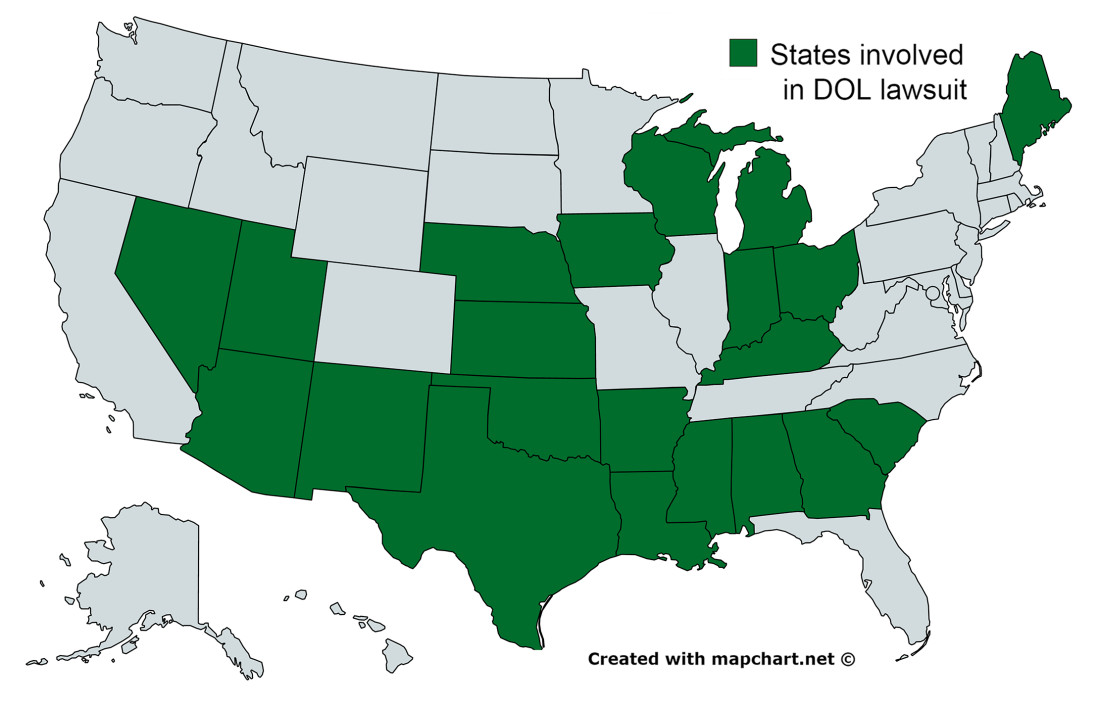 Twenty-one states have filed suit against the federal government seeking a preliminary and permanent injunction to block the Department of Labor’s new overtime rule and declare it unlawful.
 The enforcement of anti-retaliation provisions in new injury and illness reporting regulations for employers has been delayed until Nov. 1, 2016.
 On July 28, 2016, the U.S. Court of Appeals for the Seventh Circuit ruled in a precedential decision that existing civil rights laws do not protect against sexual orientation discrimination. Although it was a unanimous decision, the court expressed great displeasure and conflict with the “illogical” legal structure in which “a person can be married